
Solar panels for landlords and rented homes in Malta
Malta's REWS household schemes say plainly that a landlord cannot apply. The grant-free feed-in tariff route is open to non-residential premises, but no published source settles how income and bill savings are divided between owner and tenant, or how a let property's export income is taxed.
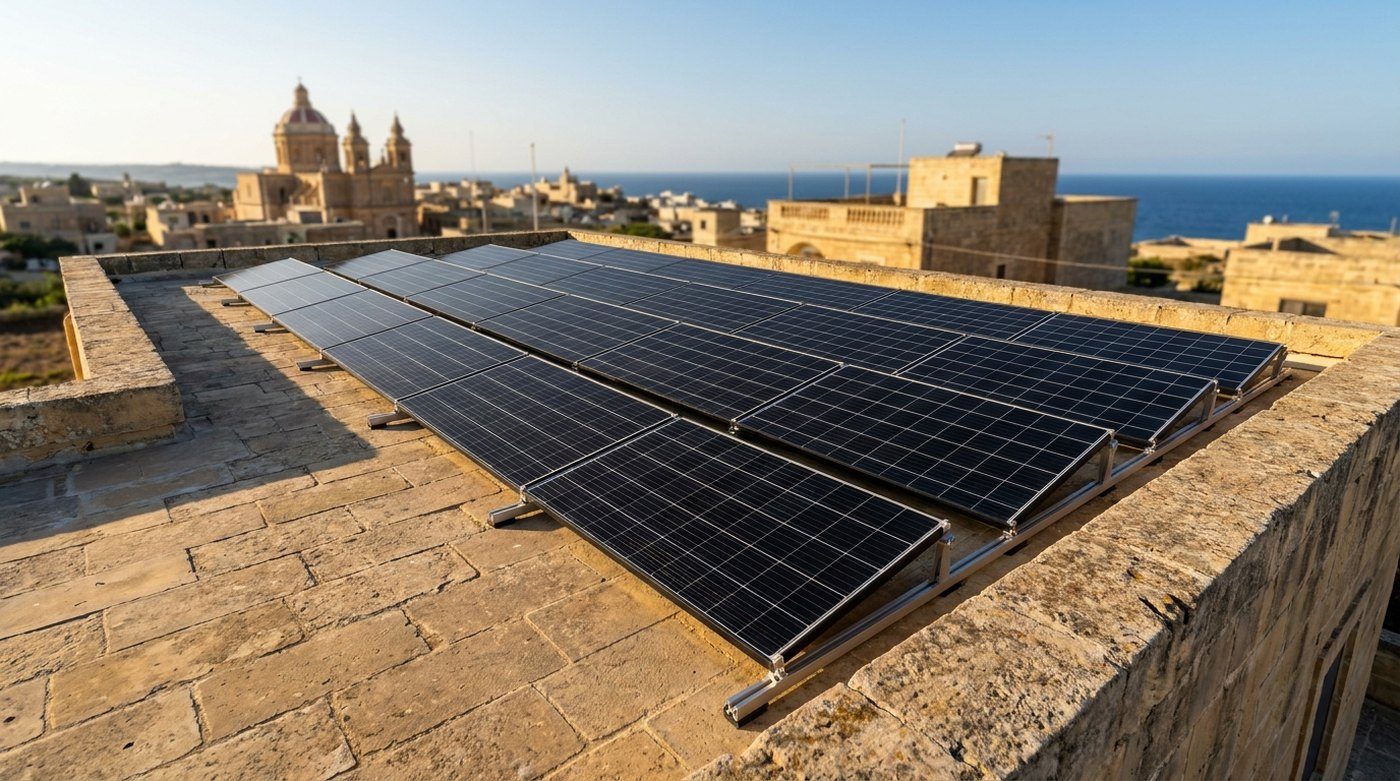
If you own property in Malta or Gozo that you let to someone else, the grant question is settled and the answer is no. Everything interesting about your decision happens after that.
The exclusion is written down, not inferred
The Guidelines for Applicants – 2026 RES Scheme define "domestic use" in a way that excludes use by landlords, developers, or anyone carrying on an economic activity at the property. The applicant must be the owner or emphyteuta, or else hold a long lease running longer than the scheme's durability period with the owner's consent, and the property must be used mainly by the applicant or their family as their own home. The guidelines then close the obvious loophole: no grant where the property is mainly used for business, including commercial letting, "even if the tenants' use ... will be residential."
The scheme page itself is narrower still — open to private individuals for their residential properties, and to non-economic organisations. That is the whole eligible population.
This is not a quirk of the PV scheme. The RIDG 2023 guidelines for roof insulation and double glazing require that the applicant "not be a landlord of the property" and rule out commercial letting; the 2025 water heater scheme is for individuals and their residential property only. Three schemes, one rule.
And the 2026 RES Scheme is closed anyway. Part A for Options B and C (the battery options) stopped on 13 July 2026, and all applications stopped on 12 September 2026 under a Government Notice dated 4 September 2026. A further round has been announced, but no details have been published — not the rates, not the dates, not the eligibility. Nobody can tell you today whether it will treat landlords differently, and anyone who claims otherwise is guessing.
For reference, Option A paid 65% of eligible costs, capped at €3,000 per system and €645/kWp; the battery grant was 75%, capped at €6,000 and €600/kWh. Those numbers are the measure of what a landlord is not getting.
The feed-in tariff route is open
The grant-free feed-in tariff is a separate mechanism, and it is not restricted to owner-occupiers. The REWS feed-in tariff FAQs state that systems under 40 kWp apply online with REWS while capacity remains, and the European Commission's Clean Energy for EU Islands record describes the scheme as open to residential premises, non-residential buildings and institutional households. The grant-free rate is €0.15/kWh for 20 years for systems under 40 kWp.
The grant-assisted rate was €0.105/kWh in 2025 and the 2026 rate is unconfirmed — but it is irrelevant to a landlord, because the grant that triggers it is unavailable. One condition does cut the other way: to qualify for a RES grant at all, the PV must have no active feed-in tariff allocation. If a further round ever does open to let property, an existing contract could complicate it.
Capacity for the grant-free tariff is finite and tracked on the REWS "PV Capping Status" page. We have not been able to load that page, so we cannot tell you what is left. Check it before you plan around the rate. If no feed-in tariff is available, Regulation 4A allows export at a market-price proxy instead — a real fallback, but not a fixed twenty-year number.
Who holds the meter decides who benefits
This is where rentals get genuinely awkward, and where the published sources stop.
The feed-in tariff is paid to the owner of the PV system. The savings from electricity consumed on site reduce the electricity bill, which goes to whoever holds the ARMS account. ARMS Form F allows a tenant to hold that account as a non-owner — "Rental purposes (Non-owner)" — with a €500 deposit. So in the common arrangement, where the tenant is the registered consumer, the landlord owns the asset and the tenant captures the self-consumption benefit.
The FAQs add a structural point: a third-party system owner who is not the registered consumer at the site must use a "sell all" export arrangement. In plain terms, if you are not the name on the meter, you cannot offset the tenant's consumption — everything generated is exported and paid at the tariff. That turns the decision into a clean one. Either you take the account yourself and build electricity into the rent, or you sell all and treat the roof as a generating asset with nothing to do with the tenancy.
Form F also notes that where PV exists, REWS must be informed when the consumer changes. Factor that into tenant turnover.
What nobody publishes is how you are supposed to split the value. There is no REWS guidance on dividing feed-in tariff income and bill savings between landlord and tenant, no model clause, and no scheme designed for let housing. That is an accountant and a lawyer question, settled in the lease.
Tax: two cases are answered, yours is not one of them
The REWS FAQs say commercial PV revenue is taxed as normal business income, and that residential feed-in tariff income is exempt from income tax and VAT. Letting sits between those two descriptions and the FAQ does not address it. Nor does any source we have say whether a holiday let counts as commercial. We are not going to invent an answer. Ask an accountant before you sign a twenty-year contract.
What the roof will actually do
PVGIS annual yields for Malta, per kWp installed:
| Orientation | kWh/kWp per year |
|---|---|
| South, 32° tilt | 1,668 |
| Flat | 1,476 |
| East | 1,376 |
| West | 1,393 |
| Gozo | 1,677 |
For a self-consumption calculation, the Enemalta residential bands including 5% VAT are €0.1047/kWh to 2,000 kWh, €0.1298 to 6,000, €0.1607 to 10,000, €0.3420 to 20,000, and €0.6076 above that. The jump at 10,000 kWh is where self-consumption stops being marginal — but in a let property the person crossing that threshold is usually the tenant, not you.
Rooftop PV is permitted development under DNO Class 1(iv), S.L. 552.08, provided the installation complies with DC15. Apartment blocks bring condominium rules into it regardless; the FAQs note that maisonette owners with roof access may connect roof PV to their own meter, which is the cleanest case in a divided building. Gozo adds a ferry crossing to every delivery and every return visit.
Our savings calculator shows its workings and its assumptions. If you want a layout before you commit, SpecYourSolar plans the roof; StoreYourSolar covers batteries, which are worth less in a sell-all arrangement than in an owner-occupied one; and CheckYourSolar lists CheckYourTraders-verified installers.
Common questions
- Can a landlord claim the REWS PV grant on a property they let out?
- No. The 2026 RES Scheme guidelines define 'domestic use' so as to exclude use by landlords, developers or anyone carrying on an economic activity at the property, and state there is no grant where the property is mainly used for business including commercial letting, 'even if the tenants' use will be residential'. The same exclusion appears in the roof insulation and double glazing scheme and the water heater scheme. In any case, the 2026 scheme closed to all applications on 12 September 2026 (battery Options B and C stopped on 13 July 2026). A further round has been announced but not detailed.
- Can my tenant apply for the grant instead?
- Only in narrow circumstances. The applicant must be the owner or emphyteuta, or hold a long lease longer than the scheme's durability period with the owner's consent, and the property must be used mainly by the applicant or their family as their own home. A standard short residential lease does not meet that. And the 2026 scheme is closed to new applications in any case.
- Which feed-in tariff applies to a rented property?
- The grant-free feed-in tariff. For systems under 40 kWp this was €0.15/kWh for 20 years, applied for online with REWS while capacity remains, and the European Commission's Clean Energy for EU Islands record describes it as open to residential premises, non-residential buildings and institutional households. The grant-assisted rate was €0.105/kWh in 2025; the 2026 rate is unconfirmed, and it is not the relevant rate here because no grant is available to a landlord.
- Who gets the money — me or my tenant?
- The feed-in tariff is paid to the owner of the PV system. The bill savings from self-consumed electricity accrue to whoever holds the ARMS account, which under Form F can be the tenant as a non-owner, subject to a €500 deposit. No source we have found explains how landlords and tenants are supposed to divide those two streams, or whether a rent adjustment is the expected mechanism. Ask an accountant and put it in the lease.
What we could not establish
- No REWS scheme aimed at rental properties or landlords was found — the exclusion is stated, but no alternative route for let housing is published.
- No guidance was found on how feed-in tariff income and bill savings should be split between a landlord and a tenant, or on what a lease should say about it.
- Whether feed-in tariff income from a let property is taxable is not settled. The REWS FAQ addresses only 'residential' (exempt from income tax and VAT) and 'commercial' (taxed as normal business income); letting is not addressed either way.
- Whether a holiday let counts as 'commercial' for feed-in tariff and tax purposes is not stated in any source we have.
- The REWS 'PV Capping Status' page was not loaded, so we cannot say how much grant-free feed-in tariff capacity remains.
- Private Residential Leases Act (Cap. 604) provisions on alterations such as roof PV, and what consent a tenant in occupation can or must give, were not researched.
- There is no neutral published 2026 installed price per kWp for Malta, and no published Malta battery price. Any figure you are shown is a quotation, not a market rate.
- How a let property's electricity account is classified for tariff banding purposes is not addressed by the sources used here.
Sources
- Guidelines for Applicants - 2026 RES Scheme — REWS · read 2026-10-26
- 2026 Renewable Energy Sources Scheme — REWS · read 2026-10-26
- Feed-in Tariffs Schemes - FAQs — REWS · read 2026-10-26
- Feed-in tariff scheme for electricity generated from solar PV installations — European Commission, Clean Energy for EU Islands · read 2026-10-26
- Registration of Change in Consumer (Form F) — ARMS Ltd · read 2026-10-26
- RIDG 2023 Guidelines (Roof Insulation & Double Glazing) — REWS · read 2026-10-26
Want this costed properly?
The calculator gives you a figure in a minute. A site visit gives you a fixed price.
Book a free survey