
How Enemalta's tariff bands decide what solar saves you
The same solar system saves a 12,000 kWh household roughly two and a half times what it saves a 4,000 kWh household — not because it generates more, but because of where in the tariff the units are removed from.
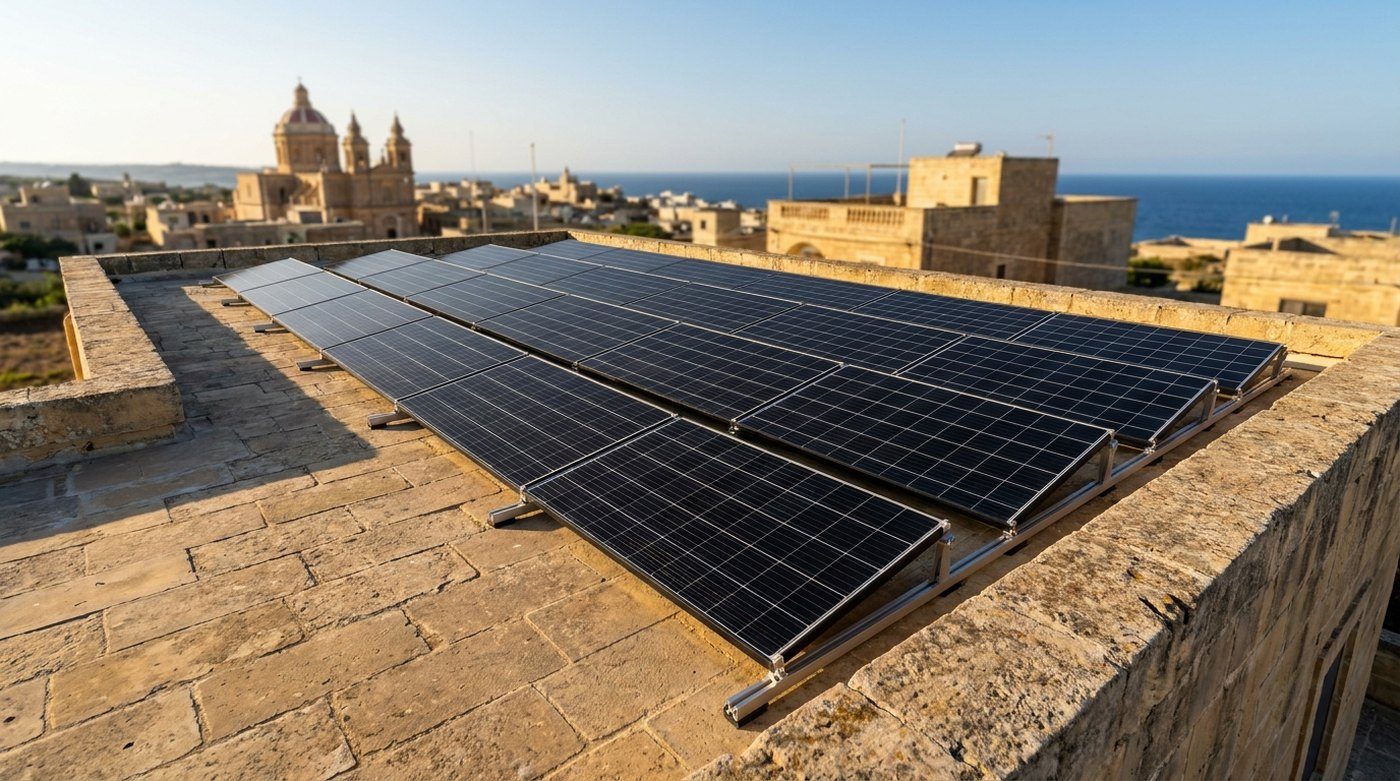
Most explanations of solar savings start with how much a system generates. In Malta that is the second question. The first is what your electricity currently costs — and because Enemalta's residential tariff is banded cumulatively over the billing year, that answer changes as the year goes on.
The bands
These are the residential rates effective 6 February 2026, including 5% VAT. The bands are cumulative over the billing year: the first 2,000 kWh you use are charged at the first rate, the next 4,000 at the second, and so on.
| Consumption in the billing year | Rate (€/kWh, incl. 5% VAT) |
|---|---|
| 0 – 2,000 kWh | 0.1047 |
| 2,001 – 6,000 kWh | 0.1298 |
| 6,001 – 10,000 kWh | 0.1607 |
| 10,001 – 20,000 kWh | 0.3420 |
| Above 20,000 kWh | 0.6076 |
The jump that matters is between the third and fourth band. Crossing 10,000 kWh more than doubles the price of every further unit, from 0.1607 to 0.3420 €/kWh. Crossing 20,000 kWh does it again, to 0.6076.
Separately, there is a service charge of €65 a year on a single-phase supply and €195 a year on triple-phase. It is not consumption-based, so no solar system touches it. Whatever else you read about eliminating your bill, that line stays.
Enemalta also applies an eco-reduction for small households. Our reading of the tariff page confirms it exists but we are not reproducing a value or an eligibility threshold here, because we cannot source one precisely — see the gaps note. If you are a low-consumption household, check your own bill rather than a figure from any website.
Solar comes off the top, not off the average
This is the whole point of the article. Self-consumed solar reduces the number of units you import over the year. Because the bands fill from the bottom up, the units you stop importing are the last ones — the ones in your highest band.
So the value of a self-consumed kilowatt-hour is not your average tariff. It is your marginal tariff: the price of the last band you reach.
A household on 4,000 kWh a year finishes in the second band. Its marginal unit costs 0.1298. A household on 12,000 kWh finishes in the fourth band. Its marginal unit costs 0.3420 — 2.6 times as much.
Two households, one system
Take a 3 kWp array on a south-facing roof at 32°, the optimal tilt for Malta. PVGIS v5.3 gives 1,668 kWh/kWp per year there, so the array generates about 5,004 kWh. Assume, purely for illustration, that 2,000 kWh of that is used in the house as it is produced and the rest is exported.
Household A uses 4,000 kWh a year. Its annual energy charge is 2,000 × 0.1047 + 2,000 × 0.1298 = €469.00, plus €65 service charge.
Household B uses 12,000 kWh a year: 2,000 × 0.1047 + 4,000 × 0.1298 + 4,000 × 0.1607 + 2,000 × 0.3420 = €2,055.40, plus €65.
Now remove 2,000 self-consumed kWh from each:
| Household A (4,000 kWh) | Household B (12,000 kWh) | |
|---|---|---|
| Band the removed units sat in | 0.1298 €/kWh | 0.3420 €/kWh |
| Value of 2,000 kWh self-consumed | €259.60 | €684.00 |
| Exported 3,004 kWh at €0.15 | €450.60 | €450.60 |
| Total benefit | €710.20 | €1,134.60 |
Identical hardware, identical roof, identical generation. The difference is entirely the tariff band the units came out of.
Note what the export column does: it is the same for both, because the grant-free feed-in tariff of €0.15/kWh for 20 years on systems under 40 kWp does not care who you are. That makes it the great leveller in Maltese solar arithmetic — and it leads to a conclusion that surprises people.
When exporting is worth more than using it
Compare €0.15 against the bands. It beats 0.1047, it beats 0.1298, it beats 0.1607. It is only below 0.3420 and 0.6076.
For a household that never crosses 10,000 kWh in the billing year, an exported unit is worth more than a self-consumed one under the grant-free tariff. Chasing self-consumption — shifting the washing to midday, adding a battery — is working against the economics rather than for them. For a household above 10,000 kWh, the reverse is emphatically true: every unit kept out of the fourth band is worth 0.3420, more than twice the export rate.
This is also why batteries make sense for some Maltese households and not others. A battery moves evening consumption off the grid. If your evening units cost 0.1298, you are buying hardware to avoid 13 cents. If they cost 0.3420, you are avoiding 34 cents. There is no neutral published Maltese battery price, so we are not going to put a payback figure on that — the comparison is between the two marginal rates, and only you know yours. The battery guide sets out what the decision actually turns on.
One qualification on the feed-in tariff: the grant-assisted rate was €0.105/kWh in 2025 and the 2026 rate is unconfirmed. The €0.15 figure above applies to grant-free installations.
Second homes are billed differently
A property that is not your ordinary residence goes on the domestic (non-residential) tariff. Enemalta publishes those rates as 0.1365 / 0.1673 / 0.2023 / 0.4180 / 0.6860 €/kWh. We hold these at medium confidence: the page does not carry a date, and it does not publish the consumption thresholds that separate the bands.
Every one of those rates is above its residential counterpart. For the many British and other EU owners in Malta and Gozo running a second property or a letting unit, that raises the value of each self-consumed unit — and because the top-band rate of 0.4180 is well above €0.15, self-consumption beats export sooner on this tariff than on the residential one.
What this does to roof choices
Band economics set the value per kWh. PVGIS sets the number of kWh. Both matter, and they are independent.
- South at 32° (optimal): 1,668 kWh/kWp/yr. South at 30° is effectively the same, 1,667.
- Flat: 1,476 — 11% below optimal.
- West at 30°: 1,393 — 16% below.
- East at 30°: 1,376 — 17% below.
- Gozo at optimal tilt: 1,677, marginally ahead of Malta.
A west roof is not a disqualification; it is a 16% haircut on generation. Whether that haircut matters depends on which band the units are displacing. For a 12,000 kWh household, a west roof still removes units priced at 0.3420. For a 4,000 kWh household, it removes units priced at 0.1298 and exports the rest at €0.15 regardless of orientation. The roof planner will run your own pitch and aspect.
The paperwork, briefly
Rooftop PV is permitted development under Development Notification Order Class 1(iv), S.L. 552.08, provided the installation is DC15-compliant. In Gozo, every delivery crosses on the ferry, which affects scheduling rather than price.
On grants: the 2026 REWS RES grant closed to applications on 12 September 2026, with the battery options closing on 13 July 2026. A further round has been announced but not detailed — no rates, no terms, no opening date. Any quote that assumes a grant today is assuming something nobody has published.
To put your own numbers through the bands, the savings calculator on the homepage uses the rates in the table above, and installers listed in the directory are CheckYourTraders-verified.
Common questions
- Why does my neighbour save more from the same size system?
- Because Enemalta's residential bands are cumulative over the billing year, solar removes units from the top of your annual consumption downwards. A household that reaches the 0.3420 €/kWh band is removing units priced at 0.3420; a household that only ever reaches 0.1298 €/kWh is removing units priced at 0.1298. Same generation, very different cash.
- Is it better to use solar electricity in the house or export it?
- It depends which band your last units sit in. The grant-free feed-in tariff is €0.15/kWh for 20 years on systems under 40 kWp. That is more than the first three residential bands (0.1047, 0.1298 and 0.1607 €/kWh), so for a modest household an exported unit is worth more than a self-consumed one. Above 10,000 kWh a year, where the band is 0.3420 €/kWh, self-consumption is worth more than double the export rate.
- Does solar get rid of the standing charge?
- No. Enemalta's service charge is €65 a year on a single-phase supply and €195 a year on triple-phase, and it is payable whatever your consumption. It sets a floor under the bill that no amount of generation reaches.
- Do second homes pay the same rates?
- No. A property that is not your ordinary residence is billed on the domestic (non-residential) tariff, which Enemalta publishes as 0.1365 / 0.1673 / 0.2023 / 0.4180 / 0.6860 €/kWh. Every band is dearer than the residential equivalent, so each self-consumed unit is worth more at a holiday let or second home than at the same consumption level in a main residence.
- Is there still a grant?
- The 2026 REWS RES grant closed to applications on 12 September 2026, with the battery options closing earlier on 13 July 2026. A further round has been announced but not detailed, so no terms, rates or opening date can be quoted.
What we could not establish
- Enemalta's residential tariff page confirms an eco-reduction for small households but we have not reproduced its value, eligibility threshold or how it interacts with the bands — do not assume a figure.
- The domestic (non-residential) rates are published without a date and without the consumption thresholds that separate the bands; we hold them at medium confidence and cannot confirm the thresholds match the residential ones.
- How the cumulative bands are apportioned across bi-monthly or estimated bills within the billing year is not established by the sources.
- There is no neutral published 2026 installed price per kWp for Malta, and no published Maltese battery price. Payback periods cannot be calculated from the sources here.
- The 2026 grant-assisted feed-in tariff rate is unconfirmed (it was €0.105/kWh in 2025), and the terms of the announced further grant round have not been published.
- No published Maltese data establishes what share of generation a typical household self-consumes; the 2,000 kWh figure used in the worked example is an illustration, not a measurement.
Sources
- Residential electricity tariffs — Enemalta · read 2026-10-16
- Domestic (non-residential) electricity tariffs — Enemalta · read 2026-10-16
- PVGIS v5.3 PVcalc (SARAH3, 14% losses) — European Commission Joint Research Centre · read 2026-10-16
Drafted with Claude — claude-opus-5, then read, corrected and approved by Neil Bennett before publication. We do not publish anything a person has not read.
Want this costed properly?
The calculator gives you a figure in a minute. A site visit gives you a fixed price.
Book a free survey