
How much do solar panels cost in Malta?
There is no neutral, dated 2026 price for a residential PV installation in Malta. Two installer pages publish figures, both old and both their own — here is what they say, how much weight to put on them, and how to build your own number instead.
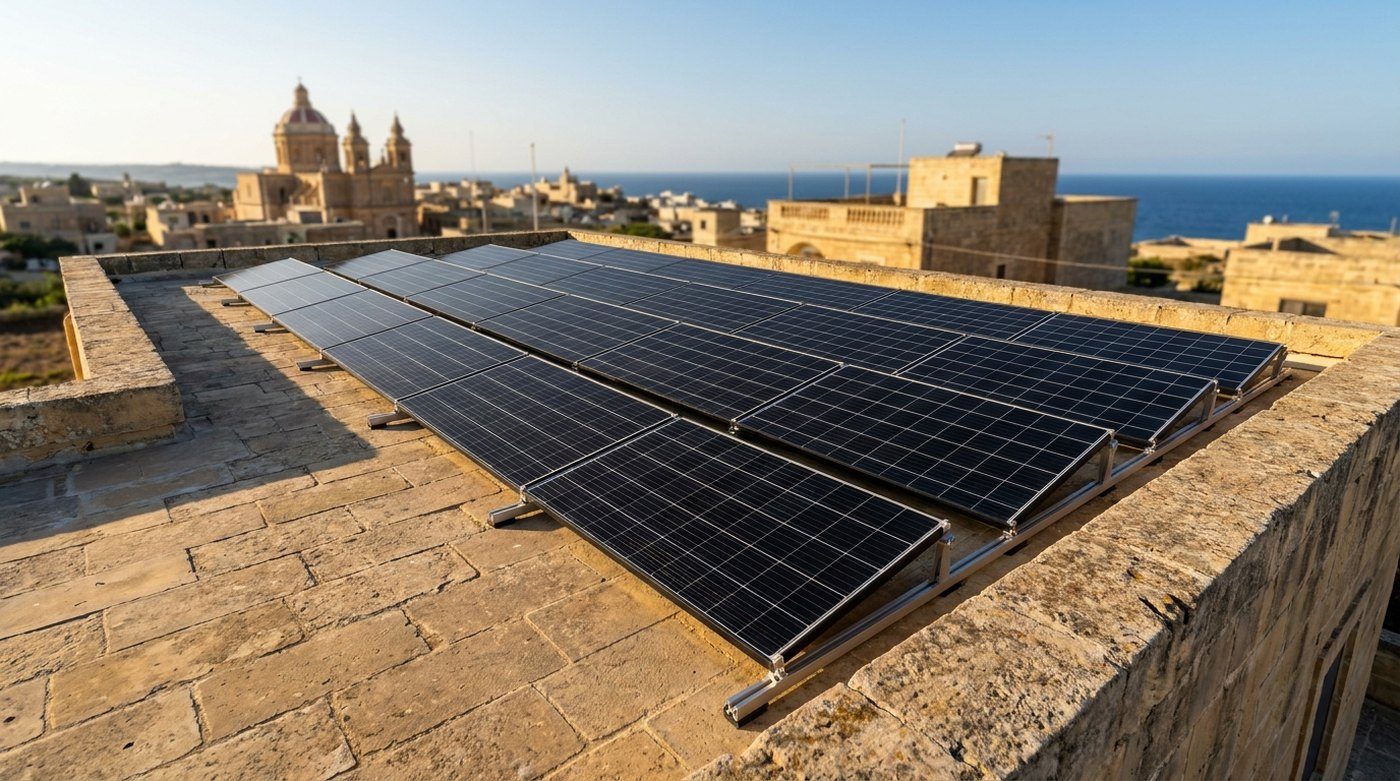
Search for this question and you will find confident numbers. Check where they come from and most of them dissolve. We could not find a single neutral, dated, 2026 source for what a residential solar installation costs in Malta — not a regulator's benchmark, not a trade body average, not a consumer survey. What exists is installers publishing figures for their own work, and the two we found are both old.
That is the honest answer, and it is worth more to you than a made-up average.
The two published figures
| Source | Figure | Dated? | Confidence |
|---|---|---|---|
| PVMalta (installer) | EUR 3,500–5,000 for a 3 kWp system, before grant | No date on the page | Low |
| Virtue Solaris (installer) | EUR 800–1,000+ per kWp installed | 2023 | Low |
PVMalta's range works out at roughly EUR 1,170–1,670 per kWp. Virtue Solaris's 2023 figure starts at EUR 800 per kWp and is open-ended at the top. The two overlap only if you read Virtue Solaris's "+" generously.
Why so little confidence? Three reasons. First, both are installers publishing their own pricing — that is not the same thing as a market rate, and neither is under any obligation to keep it current. Second, the PVMalta page carries no date at all, so you cannot tell whether it reflects 2026 module prices, 2026 labour costs or 2026 anything. Third, a per-kWp figure flattens exactly the variables that decide your bill: roof access, whether the inverter goes inside or out, cable run length, how much of the array needs ballast rather than penetration, and whether there is a battery.
Anyone quoting you a single euro-per-kWp number for Malta in 2026 is either quoting you specifically, or guessing.
What actually sits inside a quote
Ask for the quote itemised. A PV installation is not one product, and the line items move independently:
- Panels — count, rated watts each, make, model, warranty terms.
- Inverter — string or hybrid, rated kW, and whether it is battery-ready. A hybrid inverter costs more up front and saves a second visit later.
- Mounting — rails, feet, ballast. Flat Maltese roofs usually mean tilt frames; pitched or terraced roofs mean something else. This is where roofs stop being interchangeable.
- DC and AC cabling, isolators, protection — plus the run from roof to board, which on a townhouse can be long.
- Labour and access — scaffolding, hoisting, and the day rate of the crew on your roof.
- Battery, if any — as a separate line, never bundled into the system price.
- Commissioning and paperwork — the Enemalta-side work to get you exporting.
If a quote arrives as one number, ask for it broken out. You cannot compare two single numbers, and the difference between two quotes is almost always in the mounting, the access and the inverter class — not the panels.
Malta adds its own line items. In an apartment block the roof is usually common property, so condominium consent governs what you may install and where — settle that before you take quotes, not after. And in Gozo every pallet of panels and every tilt frame crosses on the ferry, which shows up in the price whether or not it is itemised.
Rooftop PV is permitted development under Class 1(iv) of the Development Notification Order (S.L. 552.08) provided the installation is DC15-compliant, so for most houses planning is not a cost line. Verify that your specific roof qualifies rather than assuming it.
Price it without a grant
The 2026 Renewable Energy Sources Scheme offered 65 per cent of eligible cost on PV plus hybrid inverter, capped at EUR 3,000 per system and EUR 645 per kWp; batteries at 75 per cent, capped at EUR 6,000 and EUR 600 per kWh; and a 5 per cent uplift for NZIA-compliant kit. The scheme opened on 20 April 2026 with a budget of EUR 15.3 million (EUR 4.1 million for PV, EUR 11.2 million for batteries) and an allocation of 8 MWp.
It is closed. Applications shut on 12 September 2026, and the battery options B and C Part A shut earlier, on 13 July 2026. A further round has been announced but not detailed — no rates, no caps, no dates, no eligibility rules. Until REWS publishes them, the only sound way to assess an offer is at full cost. If a round reopens and you qualify, that is upside; if you built your decision on it and it does not, you have bought something on a number that never existed.
The same applies to the separate hybrid-inverter replacement route Virtue Solaris summarises — 75 per cent, capped at EUR 1,800 and EUR 350 per kWp, for PV more than six years old being fitted with a battery. That is an installer's summary of scheme terms, and the scheme it belongs to is closed pending a further round that has been announced but not detailed.
The side of the equation that is firm
What you earn is better documented than what you pay. Without a grant, exported electricity from a system under 40 kWp earns EUR 0.15/kWh for 20 years. With grant assistance the rate was EUR 0.105/kWh for 20 years in 2025; the 2026 grant-assisted rate is not confirmed. That gap is the real trade-off — a grant you cannot currently apply for would also have bought you a lower export rate.
Self-consumption is worth whatever your top band costs. Enemalta's residential tariffs, including 5 per cent VAT, run 0.1047, 0.1298, 0.1607, 0.3420 and 0.6076 EUR/kWh at thresholds of 2,000, 6,000, 10,000 and 20,000 kWh. A heavy-use household shaving its 0.3420 or 0.6076 band is saving multiples of what the export rate pays.
Generation is firm too. PVGIS gives 1,668 kWh per kWp a year for a south-facing array at 32 degrees in Malta, 1,476 flat, 1,376 east, 1,393 west, and 1,677 in Gozo.
So you have solid yield, solid tariffs, and a soft cost. Which means the sensible method is to run the arithmetic with your price.
Build your own number
Our savings and payback calculator lets you set the euro-per-kWp yourself rather than inheriting ours. Put in a quote you have actually received. If you have none yet, run it twice — once near EUR 800 per kWp, once near EUR 1,670 — and look at how far payback moves. That spread is the size of the thing you do not yet know.
From there: SpecYourSolar sizes an array against your roof so you are asking every installer to price the same job, StoreYourSolar covers whether a battery earns its place before you ask anyone to price one, and CheckYourSolar sets out how installers in our directory are verified. A free roof survey turns the guesswork into a quote.
Three itemised quotes for an identically specified array will tell you more about Maltese pricing in 2026 than any article can, including this one.
Common questions
- How much does a 3 kWp system cost in Malta?
- The only published figure we can find is PVMalta's own: EUR 3,500-5,000 before grant for a 3 kWp system. That page carries no date, and it is an installer quoting its own work, so treat it as a starting point for conversation rather than a market price. It works out at roughly EUR 1,170-1,670 per kWp.
- Is the REWS grant still open?
- No. The 2026 Renewable Energy Sources Scheme closed to applications on 12 September 2026, and the battery options B and C Part A closed earlier, on 13 July 2026. A further round has been announced but not detailed — no rates, caps, dates or eligibility criteria have been published. Price your system as though you are paying the full cost.
- How much does a home battery cost in Malta?
- Nobody publishes this. Neither of the two installer pages we have gives a Maltese battery price, and we will not invent one. REWS published what the 2026 scheme would have paid towards a battery — 75 per cent, capped at EUR 6,000 and EUR 600 per kWh — but that scheme is closed, with a further round announced and not detailed, and a grant cap is not a price.
- What euro-per-kWp figure should I put into the calculator?
- Use a number you have been quoted, not a number from an article. If you have no quotes yet, run the calculator across a range — the two published installer figures span roughly EUR 800 to EUR 1,670 per kWp — and see how much the payback moves. If the answer changes your decision, you need quotes before you decide.
What we could not establish
- No neutral, dated 2026 installed price for a Maltese residential PV system exists in any source we have found. Both published figures come from installers quoting their own work.
- No Maltese home battery price is published anywhere in our sources — not per kWh, not per unit, not installed.
- The rates, caps, opening date and eligibility rules of the further REWS round are not published. Only the fact of the announcement is.
- The 2026 grant-assisted feed-in tariff rate is not confirmed. The EUR 0.105/kWh figure is the 2025 rate.
- No source breaks out the cost of scaffolding, crane hire, roof waterproofing reinstatement, or the Gozo ferry surcharge on deliveries.
- No source states how much of a typical quote is panels versus inverter versus labour.
Sources
- Government incentives — PVMalta (installer) · read 2026-10-16
- Government grants — Virtue Solaris (installer) · read 2026-10-16
- 2026 Renewable Energy Sources Scheme — Regulator for Energy and Water Services (REWS) · read 2026-10-16
- New REWS incentives to boost solar and battery storage in homes — TVM News · read 2026-10-16
Drafted with Claude — claude-opus-5, then read, corrected and approved by Neil Bennett before publication. We do not publish anything a person has not read.
Want this costed properly?
The calculator gives you a figure in a minute. A site visit gives you a fixed price.
Book a free survey