
Store your solar, use it after dark — and find out honestly whether a battery pays on your Enemalta band before you buy one.
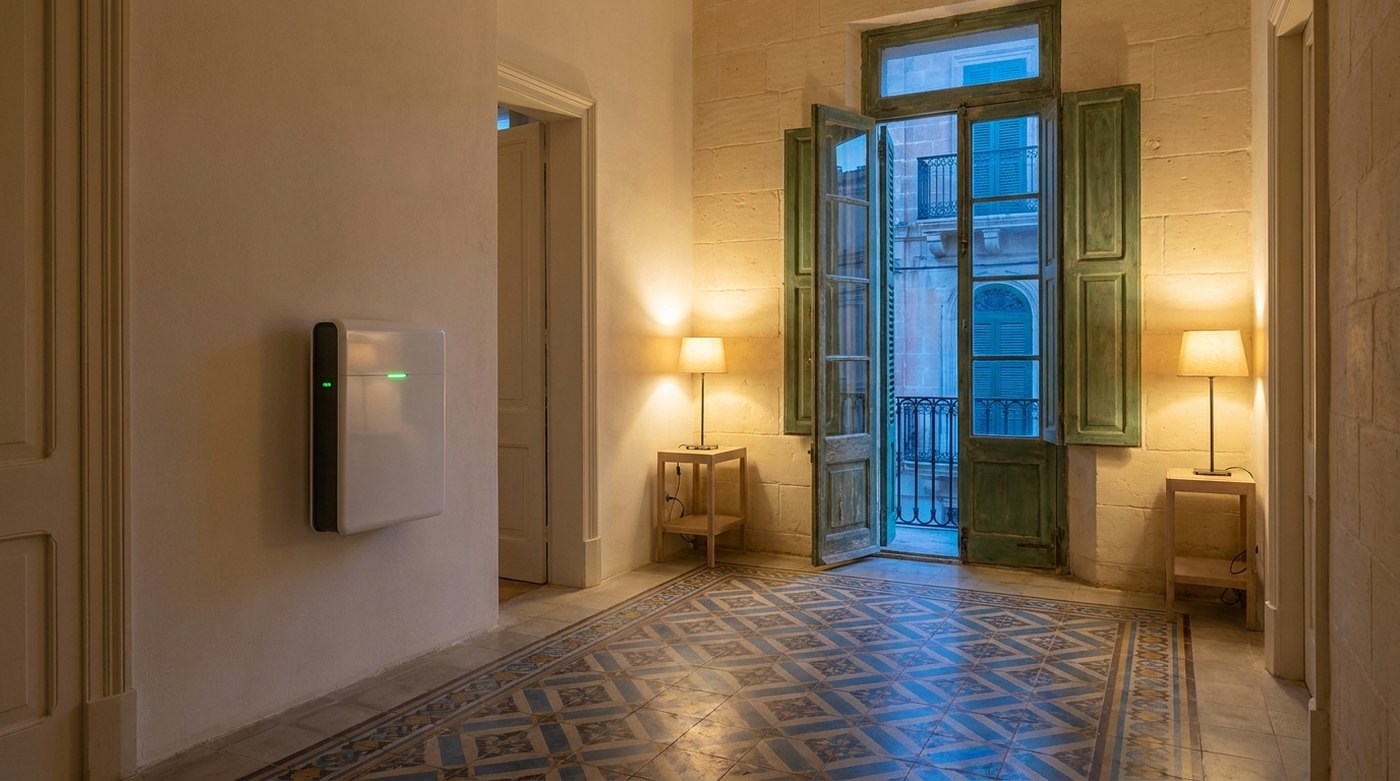
StoreYourSolar is MaltaSolar.mt’s guide to home batteries. A battery keeps the solar you would otherwise export and lets you use it in the evening. Whether that pays in Malta comes down to two numbers: what an exported kilowatt-hour earns, and what the electricity it replaces would have cost you. Here those two numbers are unusually close, so the honest answer is “sometimes”.
Work it out with your own figures in the battery calculator →
Without a grant, a system under 40 kWp earns €0.15 for every kWh it exports, for 20 years. Every kWh a battery shifts into your evening is a kWh you no longer export, so it gains your Enemalta band and gives up that €0.15. Enemalta’s residential tariff is banded over the year, including 5% VAT, and solar you use yourself comes off the top band first:
| Your consumption in the year | Enemalta rate per kWh | Each stored kWh, against €0.15 export |
|---|---|---|
| Up to 2,000 kWh | €0.1047 | −€0.0453 — storing loses money |
| 2,001 to 6,000 kWh | €0.1298 | −€0.0202 — storing loses money |
| 6,001 to 10,000 kWh | €0.1607 | +€0.0107 |
| 10,001 to 20,000 kWh | €0.3420 | +€0.1920 |
| Above 20,000 kWh | €0.6076 | +€0.4576 |
So at the grant-free €0.15 tariff a battery often does not pay back for a household using less than about 6,000 kWh a year: it swaps an export that earns €0.15 for a saving worth €0.13 or less. Between 6,000 and 10,000 kWh the gain per kWh is about a penny. Above 10,000 kWh, where the rate jumps to €0.3420, is where a battery starts to make clear sense. Charging losses and battery ageing are left out of the table, so the real figures are a little lower.
If you took a grant, the feed-in rate was €0.105 per kWh for 20 years in 2025 (the 2026 grant-assisted rate has not been confirmed), which narrows the gap. The grant and the grant-free tariff are mutually exclusive: you choose one.
The 2026 REWS renewable energy scheme paid 75% of a battery’s eligible cost, capped at €6,000 per system and €600 per kWh. Its battery options closed on 13 July 2026 and the whole scheme on 12 September 2026, after more than 3,350 applications. The government announced a further round later in the year but has not published its scope, rates or dates, so do the sums without a grant until it does. Under the 2026 rules the application had to go in before anything was bought, the battery had to be over 2 kWh and on the REWS-registered equipment list, and the installer had to give a 10-year warranty.
We have found no published Maltese battery price per kWh, so we do not show one. Divide the price you are quoted by the battery’s usable kWh and put that into the battery calculator, which works out the extra benefit a year from your own consumption, roof and system size. An older PV system may need a hybrid inverter to run a battery; the survey checks what you have.
We size the battery against what you currently export, give you an honest view on whether it pays on your band, quote it itemised, and deliver it through a solar installer from the CheckYourTraders-verified network — see CheckYourSolar for how they are vetted. More on the installation itself is on our battery storage service page.
It opens like an app, and the cost calculator works without a signal.