
Feed-in tariff in Malta: €0.15 or €0.105 with a grant?
A system under 40 kWp installed without a grant earns €0.15/kWh for 20 years. A grant-assisted system earned €0.105/kWh in 2025. You cannot have both — and because €0.15 sits above the first two Enemalta bands, low-consumption homes may do better exporting than storing.
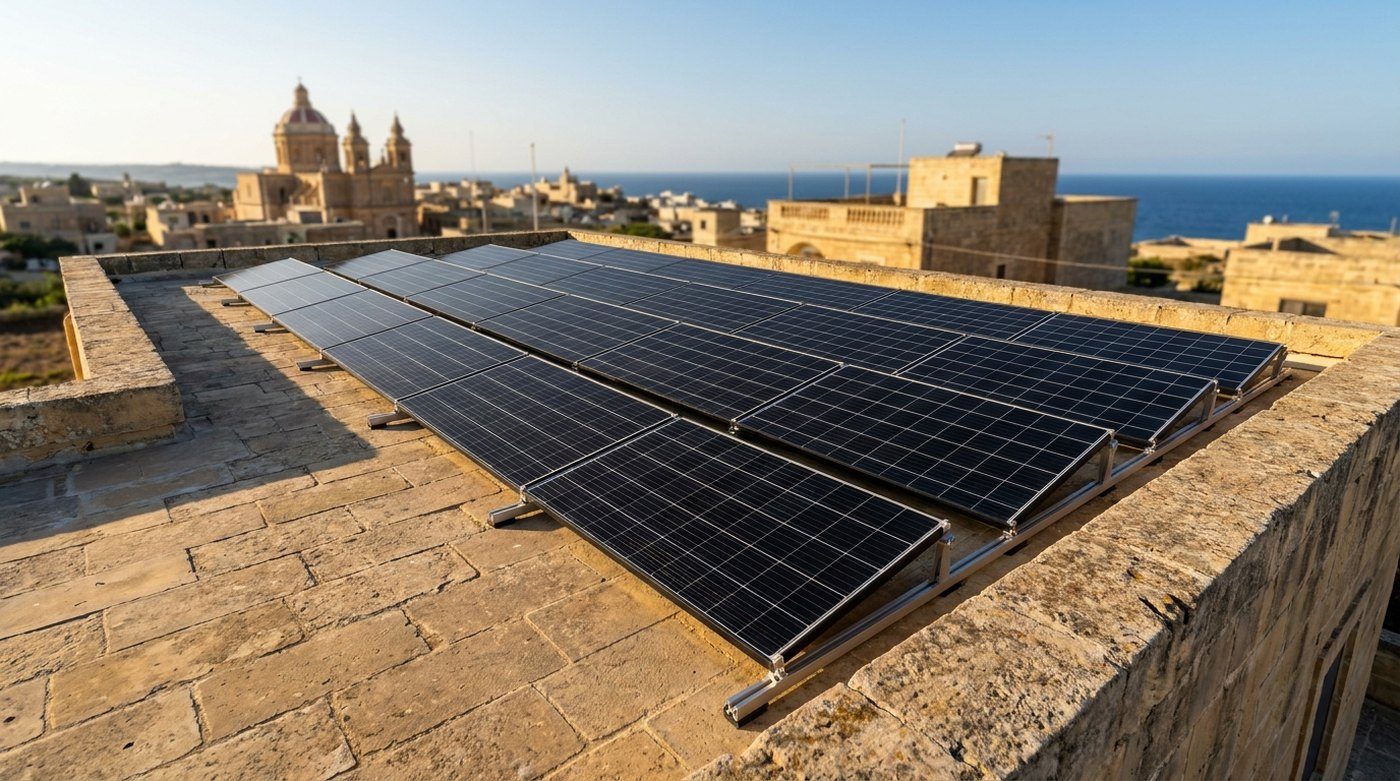
Two feed-in tariffs exist in Malta and you can only be on one of them. If you install a system under 40 kWp without taking a capital grant, the grant-free tariff pays €0.15/kWh for 20 years. If you take the grant, the tariff is lower — €0.105/kWh for 20 years was the 2025 rate, and the 2026 grant-assisted rate is not confirmed anywhere we can check.
The REWS 2026 guidelines are explicit that the grant and the grant-free tariff are mutually exclusive. That is a one-time, irreversible choice made at application, and it is worth understanding before anyone quotes you anything.
One thing has to be said up front, because it changes the shape of the decision: the 2026 grant closed to applications on 12 September 2026, with the battery options closing earlier on 13 July 2026. A further round has been announced but not detailed — no rate, no budget, no opening date, no criteria. Every grant sentence in this article carries that caveat.
Why €0.15 is not automatically good news
The instinct from the UK is that self-consumption always beats export, because export rates there have historically been a fraction of retail. Malta does not work like that, because Maltese residential tariffs are cumulative over the calendar year and start very low.
Enemalta's residential bands, including 5% VAT:
| Annual kWh consumed | Enemalta rate | Versus €0.15 export | Which wins |
|---|---|---|---|
| 0–2,000 | €0.1047 | €0.0453 worse | Export |
| 2,001–6,000 | €0.1298 | €0.0202 worse | Export |
| 6,001–10,000 | €0.1607 | €0.0107 better | Self-consumption |
| 10,001–20,000 | €0.3420 | €0.1920 better | Self-consumption |
| Above 20,000 | €0.6076 | €0.4576 better | Self-consumption |
The crossover sits inside the third band. Below roughly 6,000 kWh a year, a unit you keep is worth less than a unit you sell. Above 10,000 kWh a year, a unit you keep is worth more than twice a unit you sell.
The standing service charge — €65/year single-phase, €195/year triple-phase — does not move with any of this. Solar does not remove it.
Worked example: a low-consumption home
A flat or small house using 2,500 kWh a year pays 2,000 kWh at €0.1047 (€209.40) plus 500 kWh at €0.1298 (€64.90): €274.30, plus €65 service charge.
Every kWh this household self-consumes displaces a unit worth €0.1298 at most, and €0.1047 once annual consumption drops below 2,000 kWh. Both are below €0.15. On the grant-free tariff, every single kWh is worth more exported than used. There is no unit anywhere in this home's bill that a battery can shift profitably — the battery would be competing against a higher-value alternative, not a lower one. That is the opposite of the advice most British arrivals bring with them.
Worked example: the displacement ladder at 9,000 kWh
A house using 9,000 kWh a year pays €209.40 + €519.20 + (3,000 × €0.1607 = €482.10) = €1,210.70, plus the service charge.
Now put 3 kWp on a south-facing roof at 32°. PVGIS gives 1,668 kWh/kWp for that orientation, so roughly 5,004 kWh a year. In Gozo the same array yields about 1,677 kWh/kWp. Flat is 1,476, east 1,376, west 1,393 — orientation moves the generation figure far more than most quotes admit.
Here is the part people miss. The value of self-consumption falls as you do it, because you are walking back down the cumulative bands:
- The first 3,000 kWh you self-consume knock you from 9,000 down to 6,000, each worth €0.1607 — €482.10 in total. Better than exporting them.
- The next kWh you self-consume are worth €0.1298. Exporting those at €0.15 earns €0.0202 more each.
- If you got all the way down to 2,000 kWh, further self-consumption would be worth only €0.1047 — a third less than exporting.
So this household's optimum is not "use as much as possible". It is: self-consume about 3,000 kWh and export the rest. The remaining 2,004 kWh at €0.15 is €300.60.
Whether you can actually self-consume 3,000 kWh from a 5,004 kWh array without storage depends on when you use power, and no source publishes Maltese self-consumption fractions. Nobody can hand you that number honestly. Our savings calculator works from your own consumption, and SpecYourSolar will size against your actual roof orientation rather than a default.
Worked example: a high-consumption home
A villa with a pool, air conditioning and an EV at 13,000 kWh a year pays €1,371.40 for the first 10,000 kWh plus 3,000 × €0.3420 (€1,026.00) = €2,397.40, plus service charge.
Every kWh displaced in that fourth band saves €0.3420 — 2.28 times the export rate. Above 20,000 kWh the rate is €0.6076, roughly four times export. For these homes self-consumption dominates completely, and the battery question becomes serious, because storage is the only way to move evening consumption into the solar day. That case is worked through in the battery guide.
What the grant route actually requires
Even leaving the rate aside, the grant carries conditions the grant-free tariff does not. From the REWS 2026 guidelines: Malta resident aged 18+; owner, emphyteuta or long-lease holder; a residential-tariff bill within the last 12 months; no landlords and no businesses; no grant for a similar system since 2010; PV above 1 kW, battery above 2 kWh; REWS-registered equipment; grid-connected; keep the system five years; a 10-year installer warranty.
The sequence matters most. Part A goes in before you purchase anything. You receive an offer letter valid eight months, install, then submit Part B with the fiscal receipt. Buying first forfeits the grant. For anyone who lets their Maltese property, the landlord exclusion rules out the grant route entirely — the grant-free €0.15 tariff is the only one of the two on the table.
The 2026 scheme ran on a €15.3m budget (€4.1m PV, €11.2m batteries) and opened on 20 April 2026. The grant-free tariff had a 2026 allocation of 8 MWp. TVM also reports a 5% uplift for NZIA-compliant equipment, without saying what the 5% is applied to.
The non-grant practicalities
Rooftop PV is permitted development under DNO Class 1(iv) of S.L. 552.08, provided the installation is DC15-compliant. In a block, the roof is usually common property and condominium rules bind the works — the REWS guidelines require ownership, emphyteusis or long lease but say nothing about how shared-roof cases are evidenced. In Gozo, every delivery crosses on the ferry; the yield is marginally better at 1,677 kWh/kWp, the logistics are not.
Installers should be checked against CheckYourSolar before you sign a 10-year warranty with them.
What is genuinely unknown
There is no neutral published 2026 installed price for PV in Malta, and no published Malta battery price. Any article that gives you a €/kWp figure as fact is making it up. The grant's own value is not in our sources either, which means the €0.15-versus-€0.105 comparison cannot be closed arithmetically — you would need the grant amount, and for the next round it does not exist yet.
What you can decide today is which side of €0.15 your marginal kWh sits on. That number is on your bill.
Common questions
- Can I take the grant and still get €0.15/kWh?
- No. The REWS 2026 guidelines make the capital grant and the grant-free feed-in tariff mutually exclusive — you pick one route at application. In any case the 2026 grant closed to applications on 12 September 2026, with the battery options closing earlier on 13 July 2026. A further round has been announced but not detailed.
- Is it better to use my own solar electricity or export it at €0.15?
- It depends which Enemalta band the kWh would have come out of. The bands are cumulative over the year and include 5% VAT: €0.1047 up to 2,000 kWh, €0.1298 to 6,000, €0.1607 to 10,000, €0.3420 to 20,000 and €0.6076 above that. Exporting at €0.15 beats self-consumption in the first two bands and loses in the third and above.
- Does the €0.15 tariff change whether I need a battery?
- Yes. A battery only earns its keep on units whose alternative use is export at €0.15. If your annual consumption after solar sits under 6,000 kWh, the units a battery would shift are worth €0.1298 or €0.1047 saved versus €0.15 exported, so storage is working against a higher-value alternative. Above 10,000 kWh a year the marginal rate is €0.3420 and the arithmetic reverses sharply.
- What happened to the €0.105 rate — is it still available?
- €0.105/kWh for 20 years is the rate recorded for grant-assisted systems in 2025. The 2026 grant-assisted rate is not confirmed in any source we have, and the grant it attaches to is closed to applications. Treat €0.105 as a historical reference point, not a live offer.
What we could not establish
- Our sources do not state whether the €0.15/kWh is paid on exported units only or on total generation. The worked examples below assume exported units, which is the conservative reading.
- The value of the 2026 capital grant itself — €/kWp, percentage, or cap — is not stated in any source we hold, so the grant route cannot be costed here.
- The 2026 grant-assisted feed-in tariff rate is unconfirmed. €0.105/kWh is the 2025 figure.
- The announced further round has no published rate, budget, opening date or eligibility criteria.
- TVM reports a 5% uplift for NZIA-compliant equipment but does not say what the 5% is applied to.
- No source publishes typical Maltese self-consumption fractions, so nobody can tell you what share of your generation you would actually use on site.
- Enemalta refers to an eco-reduction for small households but our source gives no threshold or value for it.
- The REWS guidelines require ownership, emphyteusis or long lease but do not say how roof rights are evidenced where the roof is common property in a block.
- There is no neutral published 2026 installed price for PV in Malta. One installer page, undated, lists €3,500–€5,000 for 3 kWp before grant; that is a single trader's figure, not a market rate.
- Nothing in our sources says whether an existing grant-assisted €0.105 contract can be moved onto the €0.15 tariff.
Sources
- New REWS incentives to boost solar and battery storage in homes — TVM News · read 2026-10-16
- Government incentives — PVMalta (installer) · read 2026-10-16
- Residential electricity tariffs — Enemalta · read 2026-10-16
- Guidelines for Applicants — 2026 RES scheme — REWS · read 2026-10-16
Drafted with Claude — claude-opus-5, then read, corrected and approved by Neil Bennett before publication. We do not publish anything a person has not read.
Want this costed properly?
The calculator gives you a figure in a minute. A site visit gives you a fixed price.
Book a free survey