
Malta's 2026 solar grant: what it paid and why it closed
Malta's 2026 Renewable Energy Sources scheme shut to applications on 12 September 2026 after more than 3,350 applications against a €15.3m budget. A further round has been announced but not detailed, so any sums you do today should be done grant-free.
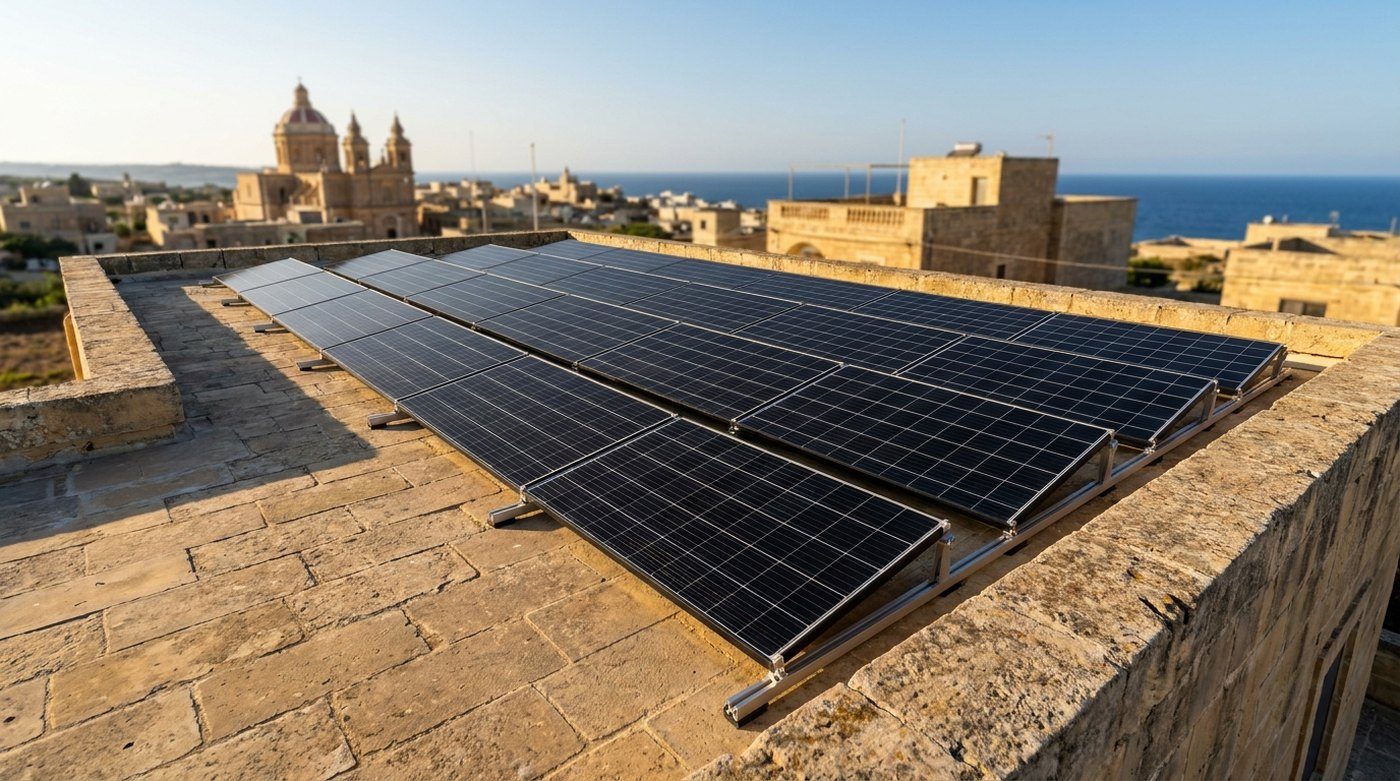
Malta's 2026 Renewable Energy Sources scheme is shut. Applications closed on 12 September 2026, and the battery options had already closed at Part A stage two months earlier, on 13 July 2026. If you have been reading older pages that still describe an open grant, they are out of date.
This page sets out what the scheme actually paid, who could claim it, how the two-stage process worked, and what is — and is not — known about the next round. The short version: a further round was announced but not detailed, so until REWS publishes terms, the honest way to cost a system in Malta is without a grant, at the €0.15/kWh feed-in tariff.
What the scheme paid
REWS announced the scheme on 16 April 2026 and opened it on 20 April. The budget was €15.3m, split €4.1m for PV and €11.2m for batteries.
| Element | Percentage of eligible cost | Cap per system | Cap per unit |
|---|---|---|---|
| PV with hybrid inverter | 65% | €3,000 | €645 per kWp |
| Battery storage | 75% | €6,000 | €600 per kWh |
Both the percentage and both caps applied — whichever bit the whole system cost, you received the lowest of the three figures. A 3 kWp system, for example, ran into the €645/kWp cap at €1,935 well before it reached the €3,000 system cap.
Kit that complied with the Net-Zero Industry Act attracted an additional 5%.
The grant and the grant-free feed-in tariff were mutually exclusive. You took one or the other. The grant-free tariff is €0.15/kWh for 20 years for systems under 40 kWp, with an 8 MWp allocation for 2026. Households that took the grant went onto the grant-assisted tariff instead, which is a lower rate.
Who could apply
The Guidelines for Applicants set out the conditions. The applicant had to be:
- resident in Malta and aged 18 or over;
- the owner of the property, the emphyteuta, or the holder of a long lease;
- able to produce a bill on a residential tariff dated within the previous twelve months;
- not a landlord and not a business;
- without a grant for a similar system at any point since 2010.
The hardware conditions: PV above 1 kW, batteries above 2 kWh, equipment on the REWS register, grid-connected, retained for five years, and covered by a ten-year installer warranty.
One of those bites harder in Malta than elsewhere: the owner/emphyteuta/long-lease test is the one that catches arrivals who are renting while they look — tenants were never in scope, whatever the landlord agreed to.
Part A and Part B
The process ran in two stages, and the order mattered.
- Part A was submitted before you bought anything. Spend first and you were out.
- A successful Part A produced an offer letter valid for eight months.
- You installed within that window.
- Part B was the claim, submitted with the fiscal receipt.
The eight-month window is worth remembering for whatever comes next. It was generous enough to absorb a Gozo installation where every pallet of panels crosses on the ferry, and it was long enough to get condominium consent for a common roof in a block — but it was not indefinite, and the receipt had to fall inside it.
Why it closed
It ran out. By 4 September 2026 more than 3,350 applications had been filed against the €15.3m budget, and the scheme was reported as oversubscribed. The battery options went first: Part A for options B and C closed on 13 July 2026, with €11.2m of the budget attached to storage. The remainder closed on 12 September.
Nothing went wrong here. A scheme paying 75% of a battery up to €6,000, in a country with Enemalta's upper tariff bands, was always going to be taken up quickly.
What comes next — and what is not known
Government said a further €5m would come "later in the year". That is the entire published extent of it. There is no announced opening date, no rates, no caps, no statement of whether PV and batteries will both be covered, and no confirmation of whether the €5m is additional money or a reallocation. Anyone telling you the next round will match the last one is guessing.
Two practical consequences:
- Do not buy on the strength of an unannounced grant. If the next round repeats the Part A rule — application before purchase — buying now would disqualify you from it. If it does not repeat, you have waited for nothing.
- Do not wait indefinitely either. Every month without a system is a month of full-tariff bills.
Doing the sums without a grant
Here is how to cost a system on figures that exist today.
Generation comes from PVGIS. Per kWp installed, per year: 1,668 kWh facing south at 32°, 1,476 kWh flat, 1,376 kWh east, 1,393 kWh west, and 1,677 kWh in Gozo. Multiply by your system size.
Value comes from two places. Electricity you use yourself displaces Enemalta's residential rates, which including 5% VAT run 0.1047, 0.1298, 0.1607, 0.3420 and 0.6076 €/kWh at the 2,000, 6,000, 10,000 and 20,000 kWh band thresholds. Electricity you export earns €0.15/kWh for 20 years on the grant-free tariff.
Notice what that comparison does. At €0.15, exporting pays more than self-consumption saves for a household sitting in the first two bands — and far less than it saves for a household running air conditioning into the 0.3420 or 0.6076 bands. Where your annual consumption lands is therefore the single biggest input into whether a battery makes sense, more so than panel orientation. Our battery guide works through that.
For a first pass, the savings calculator on the homepage and the free roof planner use these same PVGIS and Enemalta figures. For quotes, the verified installer directory lists CheckYourTraders-verified installers.
One last point on cost: there is no published, independent installed price per kWp for Malta, and no published battery price. Treat any single headline figure — including one from us — as a quote, not a market rate. Get three.
Common questions
- Is there a solar grant open in Malta right now?
- No. The 2026 RES scheme closed to applications on 12 September 2026, and the battery options closed at Part A stage on 13 July 2026. Government said a further €5m would follow later in the year, but the scope, rates, caps and opening date have not been published.
- Could I take the grant and the €0.15 feed-in tariff together?
- No. The REWS guidelines make the grant and the grant-free feed-in tariff mutually exclusive. The €0.15/kWh rate for 20 years, for systems under 40 kWp, is the grant-free route.
- If the next round pays the same, am I better off waiting?
- Nobody can tell you, because nothing about the next round has been published — not the rates, not the caps, not the date. A system installed now earns €0.15/kWh for 20 years on the grant-free tariff and starts cutting bills immediately. Waiting trades a known tariff for an undefined scheme.
- Do I need a planning permit for a rooftop system?
- Rooftop PV is permitted development under Class 1(iv) of the Development Notification Order, S.L. 552.08, provided the installation complies with DC15. An apartment roof is a separate question: the condominium rules govern who may use common parts.
- I rent out the property. Was I eligible?
- No. The 2026 scheme excluded landlords and businesses. The applicant had to be a Malta resident aged 18 or over who owned the property, held it under emphyteusis or on a long lease, and who could produce a residential-tariff bill from the previous twelve months.
What we could not establish
- The scope, rates, caps, eligibility and opening date of the announced further round. Newsbook reports a figure of €5m 'later in the year' and nothing more.
- Whether the further €5m is new money or a reallocation within the original €15.3m envelope.
- The 2026 grant-assisted feed-in tariff rate. The 2025 grant-assisted rate was €0.105/kWh; no confirmed 2026 figure appears in these sources.
- What happens to applicants holding an unused Part A offer letter if the next round changes the rates.
- Whether any part of the budget was ring-fenced for Gozo, or how the 3,350 applications split between the islands.
- A neutral, published installed price per kWp for PV in Malta, or a published battery price. No independent body publishes either, so any cost-per-kWp figure you see is a vendor's own quote and should be treated as one.
Sources
- 2026 Renewable Energy Sources Scheme — Regulator for Energy and Water Services (REWS) · read 2026-10-16
- Guidelines for Applicants — 2026 RES scheme — REWS · read 2026-10-16
- New REWS incentives to boost solar and battery storage in homes — TVM News · read 2026-10-16
- Renewable energy scheme oversubscribed as 3,350 applications flood in — Newsbook · read 2026-10-16
Drafted with Claude — claude-opus-5, then read, corrected and approved by Neil Bennett before publication. We do not publish anything a person has not read.
Want this costed properly?
The calculator gives you a figure in a minute. A site visit gives you a fixed price.
Book a free survey