
Selling or buying a house with solar panels in Malta
The buyer keeps the feed-in tariff if the REWS ownership-transfer procedure is followed and the premises stay residential. Two separate forms are involved — one at REWS, one at ARMS — and a grant-funded system adds a clause the contract of sale has to carry.
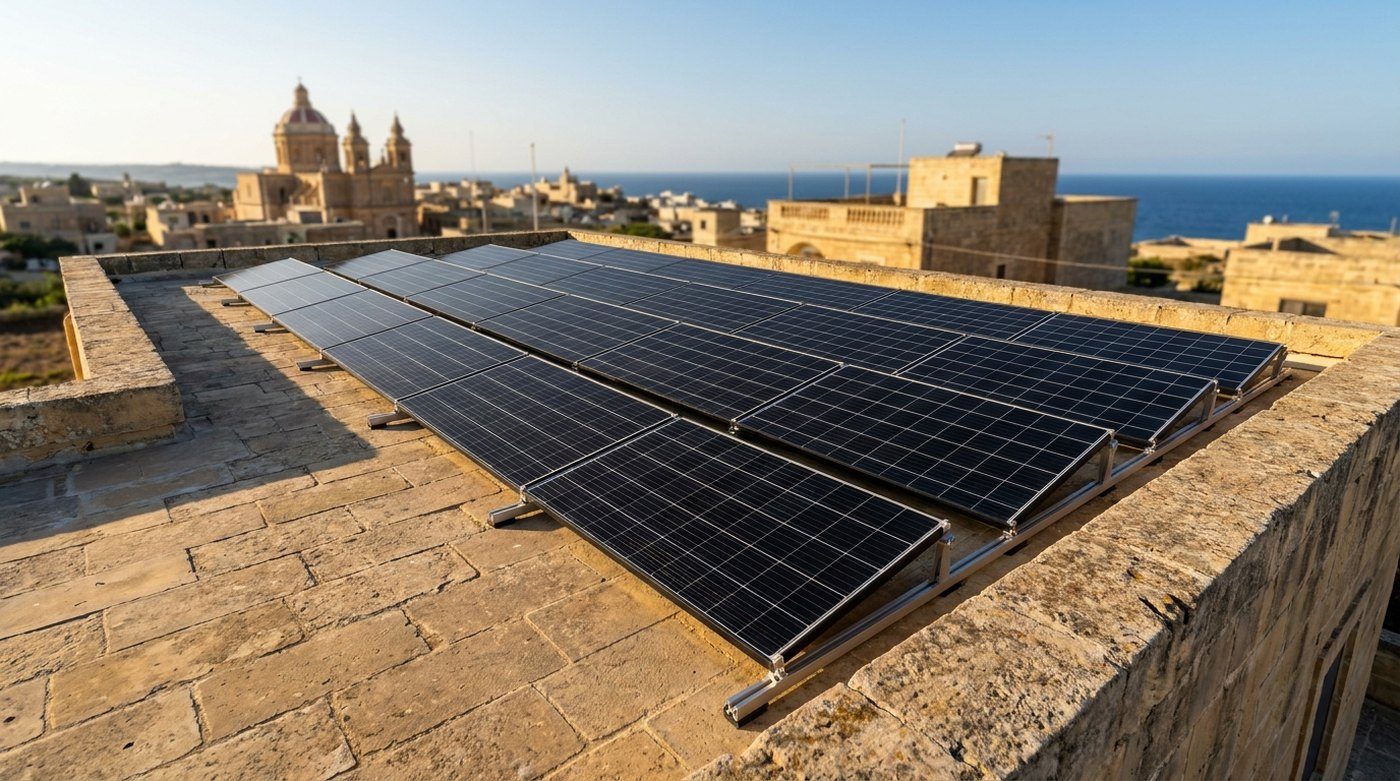
A house in Malta with a working PV system on the roof usually comes with a second asset the estate agent's listing never mentions: a feed-in tariff contract with a fixed rate and a fixed number of years left to run. It is transferable. It is also the kind of thing that quietly falls through the cracks between the seller's notary, the buyer's notary, ARMS and REWS, because three different organisations each hold one piece of the file.
This is what the published procedure actually says, and — just as usefully — what it does not say.
The buyer keeps the tariff, on two conditions
The REWS feed-in tariff FAQs are explicit: on a residential sale, the new owner keeps the feed-in tariff provided the ownership-transfer procedure is followed and the premises remain residential. Two conditions, both of which can be failed.
The period and the rate are not renegotiated. They are fixed by the scheme the PV was approved under. A system approved without a grant at €0.15/kWh for 20 years keeps that rate and that term; a 2025 grant-assisted system approved at €0.105/kWh for 20 years keeps that one. The buyer inherits whatever the original contract set, not whatever is current.
One failure mode is worth naming because it is irreversible: the REWS FAQs state that a system which is decommissioned and then sold loses eligibility. If a seller strips the roof before the deed, the tariff does not travel with the panels to a scrapyard and it does not travel with the house either.
Two forms, two organisations
REWS/253 — Application for Transfer/Relocation of a RES system. This is the form that moves the system and its tariff. Its options cover transfer of ownership (sale, donation, separation, death), relocation, change of premises type, and 'shift & add-on'. It captures the existing owner and the MRA/REWS reference number, the original address and ARMS account, and the new owner's details. Both the existing and the new owner sign it, and the declaration confirms that the original feed-in tariff and grant conditions still apply and must be honoured.
Supporting documents named on the form and the scheme page:
- identification documents;
- a copy of the contract of sale, donation or causa mortis;
- for inherited property, the death certificate and the notarial succession document;
- an engineer's completion certificate — for relocations only;
- an Enemalta no-objection letter for licensed facilities;
- a clearance letter where a grant, feed-in tariff or ITB was awarded by another contracting authority.
REWS contact points on the form are 153 and enquiry@rews.org.mt.
ARMS Form F — Registration of Change in Consumer. This is the separate utility-account transfer, and it lists purchase of property, inheritance and rental as reasons. Where a PV system is installed, Form F requires documentation from the REWS offices and states that REWS must be informed whether the PV system is moving to another address or staying put under a new owner. Three practical points from the form itself: the processing fee is €4.66; the current account holder remains liable for the bills until the transfer is processed; and it is not processed if either party has outstanding debts on other accounts. The helpline is 8007 2222.
That last condition catches people. A dispute over an unrelated arrears balance can hold up the account transfer on a property that has already changed hands.
Grant-funded systems: the contract clause
If the system was installed under a REWS grant, the obligations are heavier and they land on the notary's desk, not the installer's.
The 2026 RES Scheme guidelines say: inform REWS as soon as you decide to sell. Transfer of ownership is allowed only on death or sale. The contract of sale must state that the obligations pass from the applicant to the new owner. Changes in location or ownership during the five-year durability period are classed as substantial and require REWS authorisation.
So the clause is not optional boilerplate — it is the mechanism by which the grant stays valid. A buyer taking over a grant-funded system inside the durability window is taking over the durability obligation too, and should want to know the installation date before signing.
Separately, the guidelines note that the REWS sample 10-year guarantee passes to subsequent owners at the same location. That is worth asking the seller to produce.
On grants generally: the 2026 REWS RES grant closed to applications on 12 September 2026, with the battery options closing earlier on 13 July 2026. A further round has been announced but not detailed — no rates, no conditions, no dates. Anyone buying a house without PV and budgeting on a grant is budgeting on something that does not yet exist on paper.
What the tariff is actually worth
Two numbers set the value of an inherited system. The export rate, and the retail price of the units the system stops you buying.
Enemalta's residential bands, including 5% VAT, run 0.1047 / 0.1298 / 0.1607 / 0.3420 / 0.6076 €/kWh at consumption thresholds of 2,000 / 6,000 / 10,000 and 20,000 kWh. Self-consumption displaces units at the top of your band, which is why a large household with a pool and air conditioning gets more out of the same array than a couple who are out all day. Export is paid at the contracted feed-in rate regardless.
For output, PVGIS gives Malta yields of 1,668 kWh/kWp for a south-facing array at 32°, 1,476 flat, 1,376 east, 1,393 west, and 1,677 in Gozo. Ask which way the existing roof faces before assuming the previous owner's bills tell you anything about yours.
The REWS FAQs also note that residential feed-in tariff income is exempt from income tax and VAT, and that export mode — full or partial export — can be changed using ARMS Form R.
After the feed-in tariff term
The FAQs set out what follows the guaranteed period. Residential exports are then paid 10.5c/kWh under LN 61 of 2021: for 12 years after an 8-year feed-in tariff, or 14 years after a 6-year one. Exports are capped at 1,600 kWh per kWp per year.
For a buyer, this means an older system with an expired tariff is not worthless — it is on a different, lower, still-defined rate. Establish which regime the system is on before pricing it into the offer.
Checklist
Seller. Locate your MRA/REWS reference and your original feed-in tariff contract. If the system was grant-funded, tell REWS as soon as you decide to sell. Do not decommission the system before the deed. Sign REWS/253 alongside the buyer.
Buyer. Ask for the feed-in tariff contract (rate and term), the installation date, the 10-year guarantee document, and confirmation of whether a grant was involved. Check the premises will remain residential in your hands — converting to a licensed or commercial use is a change of premises type on the REWS form, not a neutral event. Rooftop PV on a dwelling is permitted development under DNO Class 1(iv) of S.L. 552.08 where it is DC15-compliant, so do not expect a planning permit in the file.
Notary. One line in the contract of sale stating that the RES grant and feed-in tariff obligations pass from the seller to the buyer; a diarised reminder that REWS/253 and ARMS Form F are two separate filings; and a note that the seller stays liable on the ARMS account until Form F is processed.
Because none of the sources state a REWS processing time, build in slack and confirm the current position with REWS on 153 before completion rather than after.
If you are buying a house without PV and sizing a system for it, the free roof planner covers orientation and roof area, the verified installer directory lists CheckYourTraders-verified installers, and the battery guide covers storage. The savings calculator on the homepage is sourced to the band rates above.
Common questions
- Does the feed-in tariff transfer to the buyer when the house is sold?
- Yes, according to the REWS feed-in tariff FAQs: on a residential sale the new owner keeps the feed-in tariff provided the ownership-transfer procedure is followed and the premises remain residential. The period and rate stay those of the scheme the system was originally approved under — they are not renegotiated at the point of sale.
- Is the REWS form enough, or do I also have to deal with ARMS?
- Both. The REWS/253 form transfers the RES system and its feed-in tariff; ARMS Form F registers the change of consumer on the electricity account. Form F specifically asks for documentation from the REWS offices where a PV system is installed, and says REWS must be informed whether the system moves to another address or stays where it is under a new owner. Form F carries a €4.66 processing fee, and the current account holder remains liable for bills until the transfer is processed.
- What if the system was installed with a government grant?
- The 2026 RES Scheme guidelines tell grant recipients to inform REWS as soon as they decide to sell. Transfer of ownership is permitted only on death or sale, and the contract of sale must state that the obligations pass from the applicant to the new owner. Changes of location or ownership during the five-year durability period are treated as substantial and need REWS authorisation.
- What happens to exports after the feed-in tariff term ends?
- The REWS FAQs state that once the feed-in tariff ends, residential exports are paid 10.5c/kWh under LN 61 of 2021 — for 12 years after an 8-year feed-in tariff, or 14 years after a 6-year one. Exports are capped at 1,600 kWh per kWp per year.
- Can a seller take the panels with them to a new house?
- The REWS FAQs say a second-hand system relocated to a new address keeps its feed-in tariff if the change of ownership is registered and the new premises are residential. The REWS/253 form has a relocation option, which additionally requires an engineer's completion certificate. A system that is decommissioned and then sold loses eligibility.
What we could not establish
- No REWS processing time, and no fee, is published for the transfer/relocation application. The scheme page states supporting documents but no fee.
- The current 2026 feed-in tariff rate table could not be verified — the relevant gov.mt press release returned a 403 error. The €0.15/kWh (no grant, up to 40 kWp, 20 years) and €0.105/kWh (2025 grant of 50% or less, 20 years) figures here are 2025 rates.
- It is not stated what happens if the transfer is never filed, nor whether the remaining feed-in tariff years carry over automatically on completion of the transfer. The REWS FAQ implies the guaranteed period simply continues, but does not say so in those terms.
- The 2026 REWS RES grant closed to applications on 12 September 2026 (battery options 13 July 2026). A further round was announced but not detailed, so no terms, rates or dates can be quoted for it.
- The European Commission island-scheme page gives both 40 kWp and 400 kWp as the system ceiling in different places — an internal inconsistency we cannot resolve from the sources here.
- No neutral 2026 installed price for PV in Malta, and no Malta battery price, is published by any of these sources.
Sources
- Feed-in Tariffs Schemes - FAQs — REWS · read 2026-10-26
- Application for Transfer/Relocation of a RES system (REWS/253/v2-06-05/26) — REWS · read 2026-10-26
- Transfer or Relocation of a RES system — REWS · read 2026-10-26
- Registration of Change in Consumer (Form F, ARMS/F/v3/06/07/2026) — ARMS Ltd · read 2026-10-26
- Guidelines for Applicants - 2026 RES Scheme — REWS · read 2026-10-26
- Feed-in tariff scheme for electricity generated from solar PV installations — European Commission, Clean Energy for EU Islands · read 2026-10-26
Want this costed properly?
The calculator gives you a figure in a minute. A site visit gives you a fixed price.
Book a free survey