
Solar water heater or heat pump water heater in Malta?
Two ways to stop heating water with an electric element, compared for Maltese roofs and flats — plus the order of operations for the REWS 2025 Water Heater Scheme, which runs to 31 December 2026 and requires approval before you buy.
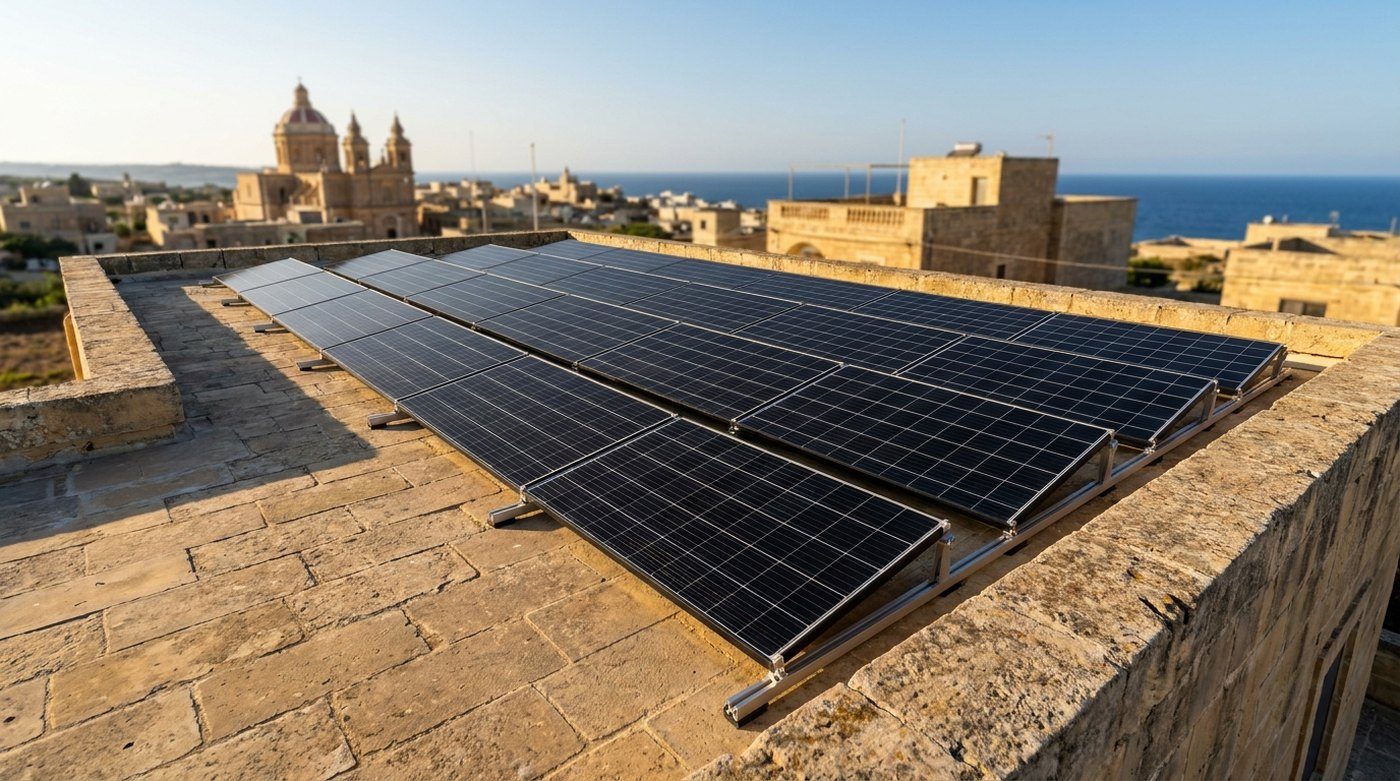
Hot water is the quiet item on a Maltese electricity bill. The University of Malta's Institute for Sustainable Energy put households at about 30% of national electricity demand, with hot water about 24% of household energy — and found that most homes make it the most expensive way possible, with an electric boiler at an overall efficiency of 0.75. An NSO survey of 1,500 households quoted in the same paper found electric boilers in 90.5% of homes and solar water heaters in 9.5%. That paper is from 2013, so treat the proportions as dated, but the pattern is familiar to anyone who has opened a shell apartment and found a bare immersion cylinder bracket on the wall.
There are two mainstream ways out of that, and they fail in different places.
How a solar water heater works
Every solar thermal system has two parts: a collector and a tank. ENERGY STAR describes three collector types:
- Batch (integral collector-storage) — the simplest, tank and collector in one.
- Flat-plate — copper tubes on an absorber plate under tempered glass. Two collectors supply roughly half the hot water needs of a family of four.
- Evacuated tube — the most efficient type; the vacuum cuts heat loss and it still performs in overcast weather, but it can cost up to twice as much per square foot as flat-plate.
Systems are also direct or indirect. Direct systems circulate the potable water itself and suit places where freezing is rare, which describes Malta. Passive systems move water by natural convection and need no pump — fewer moving parts, nothing to fail on a flat roof in August, nothing drawing electricity.
That is the appeal: on the right roof, a solar water heater is close to a zero-running-cost appliance for most of the year.
How a heat pump water heater works
A heat pump water heater does not make heat. It uses a compressor to move heat from the surrounding air into a storage tank — the US Department of Energy describes these as two to three times more efficient than conventional electric-resistance water heaters. Integrated units combine the tank with backup resistance elements for heavy demand or cold air; an existing tank can also be retrofitted with a heat pump.
It still runs on electricity, so it never gets to zero. But it needs no roof, no collector and no sun, and it can live in a washroom, a garage or a bitħa.
The real constraint in Malta is the roof
The University of Malta paper is blunt about why solar water heating stalled after the grants began in 2006 — roughly 2,000 new installations a year at the time, but against a housing stock moving the wrong way. The shift from terraced houses to apartment blocks cut the unshaded roof area available per household. Some working systems were shaded out when neighbours added storeys, because Malta has no solar rights. And in scheduled areas and village cores, appearance is a planning problem in itself.
Three practical consequences for anyone deciding today:
- In a block, the roof is usually common property. Condominium rules govern what you may put there and the REWS evidence list includes a lease contract "if applicable" and a PA permit where needed. Settle the roof question before you settle the appliance question.
- Check what can be built next to you. A collector that is shaded in three years is a write-off; the 2013 paper documents exactly that happening.
- The roof is also where your PV goes. Rooftop PV is permitted development under DNO Class 1(iv), S.L. 552.08, if it is DC15-compliant — and PVGIS gives 1,668 kWh/kWp for a south-facing array at 32° in Malta, 1,677 in Gozo, against 1,476 flat, 1,376 east and 1,393 west. Every square metre a collector occupies is a square metre not generating exportable units at the grant-free feed-in tariff of €0.15/kWh for 20 years (under 40 kWp). None of our sources publishes the area a solar water heater takes compared with the area per kWp of PV, so that trade-off has to be measured on your own roof rather than looked up. SpecYourSolar is the place to lay both out.
A heat pump water heater sidesteps all of this. It costs roof area of nothing and is indifferent to a new storey next door.
What the saving is worth
Enemalta's residential bands, including 5% VAT, run 0.1047, 0.1298, 0.1607, 0.3420 and 0.6076 €/kWh at cumulative thresholds of 2,000, 6,000, 10,000 and 20,000 kWh. The units you remove come off the top of your annual consumption, not the bottom. A household already past 10,000 kWh is displacing units at 0.3420 €/kWh; one at 4,000 kWh is displacing units at 0.1298. The same appliance is worth very different amounts in those two houses, which is why the savings calculator on our homepage asks for annual consumption rather than floor area.
The REWS 2025 Water Heater Scheme
The scheme was launched by Government Notice 581 of 2025 and extended to 31 December 2026 by GN 2034 of 2025 (the REWS page was updated on 31 December 2025). It covers solar water heaters, heat pump water heaters, and "boiler plus panels" — PV wired to the water heater.
Eligibility and process, from REWS:
- Open to private individuals for their residential property, and to non-profit organisations.
- The ARMS bill must be on a Residential/Domestic tariff in the applicant's name.
- Part A must be submitted and a REWS acceptance letter received before you buy or install anything. Decisions usually take about five weeks.
- You then have six months to install, commission and file Part B.
- Evidence includes fiscal receipts, rating-plate photos, a PA permit where needed, a copy of the system guarantee and the installer's commissioning certificate. A lease contract is required "if applicable".
- There is no application fee.
The order matters more than anything else here. Buying first disqualifies the purchase.
Grant rates as reported
These are as reported by MaltaToday on 10 April 2025, not as confirmed on the REWS guidelines — we could not load the guidelines PDF (expired certificate) or servizz.gov.mt (403).
| Measure | Rate | Cap |
|---|---|---|
| Solar water heater | 75% of cost | €1,400, plus a €500 maintenance grant after 5 years |
| Heat pump water heater | 50% of cost | €1,400 (raised from €1,000) |
| PV feeding only the water heater | 50% of cost | €700 |
| RIDG roof insulation / double glazing | 50% of cost | €1,000 |
MaltaToday also reports that output from PV panels feeding only the water heater does not count toward the household's PV meter cap. Budget 2027 is presented on 26 October 2026; these figures were checked before it and may change.
Note the asymmetry: 75% for solar thermal against 50% for a heat pump, with the same €1,400 cap. The policy clearly prefers the collector where a collector will fit.
Which is still being installed
MaltaToday reported grant uptake of solar water heaters in 525 homes (€716,390 in grants) against heat pumps in 99 buildings (€92,218). The article does not tie those clearly to a single year, so read them as proportions rather than an annual rate: heat pump water heaters remain niche in Malta next to solar thermal.
Choosing
- Terraced house or maisonette with your own unshaded roof, and no plan to fill it with PV: solar thermal, at the higher grant rate, is the obvious candidate.
- Apartment, shaded roof, scheduled area or village core, or a roof you want entirely for PV: the heat pump is the one that does not depend on roof politics.
- Shell purchase: decide during fit-out. Running the plumbing and the dedicated circuit before the screed goes down is far cheaper than retrofitting either system afterwards — and in Gozo every delivery involves the ferry, so a single co-ordinated fit-out beats two visits.
Whichever you choose, the installer's commissioning certificate is part of the Part B file, so the trade matters. Our installers are listed and CheckYourTraders-verified in CheckYourSolar. If you are also weighing storage against a hot-water load that can be shifted into daylight hours, StoreYourSolar covers that separately.
On the PV side, for completeness: the 2026 REWS RES grant closed to applications on 12 September 2026, with battery options closing 13 July 2026. A further round has been announced but not detailed. The grant-assisted feed-in tariff was €0.105/kWh in 2025 and the 2026 rate is unconfirmed; the grant-free tariff is €0.15/kWh for 20 years below 40 kWp.
Common questions
- Do I have to apply to REWS before I buy the water heater?
- Yes. Under the 2025 Water Heater Scheme you submit Part A and must receive a REWS acceptance letter before buying or installing. Decisions usually take about five weeks. After acceptance you have six months to install, commission and file Part B with fiscal receipts, rating-plate photos, a PA permit where needed, a copy of the system guarantee and the installer's commissioning certificate. There is no application fee.
- How much does the grant pay?
- As reported by MaltaToday in April 2025: a solar water heater at 75% of cost up to €1,400, plus a €500 maintenance grant after five years; a heat pump water heater at 50% of cost with the cap raised from €1,000 to €1,400; and PV panels feeding only the water heater at 50% up to €700. We could not load the REWS scheme guidelines PDF to confirm those percentages and caps, so treat them as reported figures and check the guidelines before you commit. Budget 2027 is presented on 26 October 2026 and these figures were checked before it.
- Does a heat pump water heater work in a flat with no usable roof?
- A heat pump water heater does not need a roof — it moves heat out of the surrounding air into a tank rather than making heat directly, which is why it can be two to three times more efficient than an electric-resistance heater. The constraint is the room it sits in. None of our sources gives Malta-specific minimum room volume, noise or temperature-range figures, so ask the supplier for the manufacturer's installation requirements in writing.
- Can I claim this and a PV grant for the same house?
- They are separate schemes. The 2026 REWS RES grant for rooftop PV closed to applications on 12 September 2026, with battery options closing on 13 July 2026; a further round was announced but not detailed. The Water Heater Scheme is its own route and was extended to 31 December 2026. Within it, PV wired only to the water heater is grant-aided at 50% up to €700, and MaltaToday reports that this output does not count toward the household's PV meter cap.
What we could not establish
- We could not load the REWS 2025 Water Heater Scheme guidelines PDF (downloads.rews.org.mt certificate expired) or servizz.gov.mt (403). The grant percentages and caps in this article therefore come from MaltaToday, not from the REWS guidelines — confirm them once the PDF is reachable.
- No loaded source gives Malta-specific heat pump water heater performance (COP), noise levels, or minimum installation room volume or temperature range.
- No loaded source gives the roof area a solar water heater occupies, or how that compares with the area per kWp of PV, so we cannot publish an m² trade-off for a Maltese roof.
- Product-registration requirements (for example whether a collector must hold Solar Keymark certification to qualify) are unverified in our sources.
- Whether Budget 2027, presented on 26 October 2026, changes any of these grant rates is unknown at the time of writing.
- The 2023 MaltaToday uptake figures (solar water heaters in 525 homes, grants of €716,390; heat pumps in 99 buildings, €92,218) are not clearly tied by the article to a single year.
- The University of Malta figures on how Maltese homes heat water date from a 2013 conference paper and may not describe the housing stock today.
Sources
- 2025 Water Heater Scheme — Regulator for Energy and Water Services (REWS) · read 2026-10-26
- Energy ministry announces new solar panel, water heating grants — MaltaToday (Karl Azzopardi) · read 2026-10-26
- Water Heaters: Heat Pumps (Energy Basics) — US Department of Energy, Building Science Education · read 2026-10-26
- How solar water heaters work — ENERGY STAR (US EPA) · read 2026-10-26
- Performance of a solar-assisted thermodynamic heat pump for water heating — University of Malta, Institute for Sustainable Energy (Yousif, Cubero, De Bono), ISE conference 21 Mar 2013 · read 2026-10-26
- Over 80,000 homes powered by renewable energy in 2022 — MaltaToday · read 2026-10-26
Want this costed properly?
The calculator gives you a figure in a minute. A site visit gives you a fixed price.
Book a free survey