
Hybrid inverters in Malta: what they do, when to replace
A hybrid inverter does a string inverter's job and can also charge and discharge a battery. Replacing an ageing one is the natural moment to decide on storage — and in Malta that decision turns on the Enemalta tariff bands against the €0.15/kWh feed-in tariff.
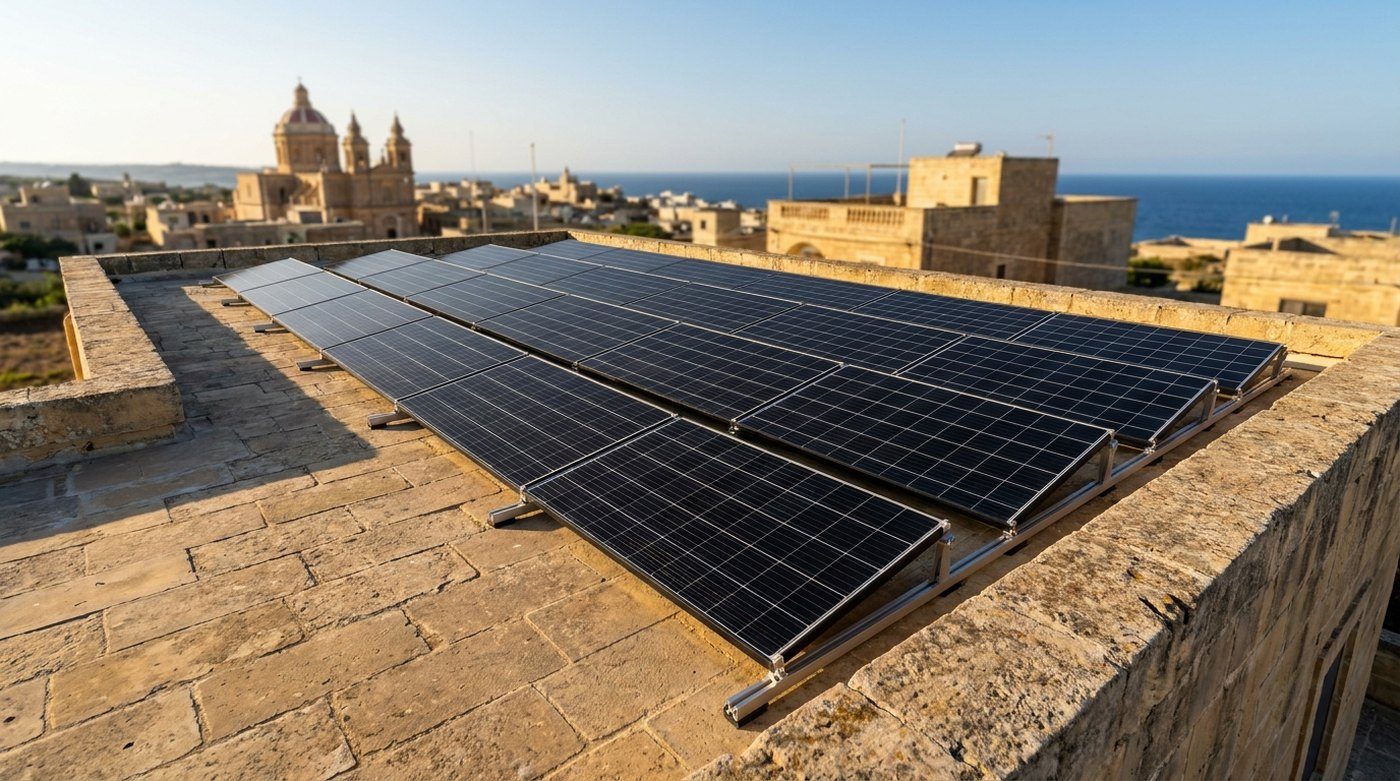
Most Maltese rooftops have a string inverter: a box, usually in a shaded corner or an indoor service area, that converts the DC electricity the panels produce into the AC electricity the house and the grid use. It is the only part of a PV system with power electronics working hard every daylight hour, and it is the part most likely to need replacing before the panels do.
A hybrid inverter does that same job and one more: it can charge and discharge a battery. Instead of bolting a separate battery inverter onto an existing AC system later, the hybrid unit sits between panels, battery, house and grid and decides where each unit of electricity goes — into the house, into the battery, or out to the network.
That is the whole of the technical story, and it is why the inverter is the component that quietly decides whether storage is a later add-on or a second rebuild.
Why replacement is the decision point
If your inverter is failing or has already failed, you are buying a box regardless. The marginal question is whether you buy one that can run a battery. You are already paying for the call-out, the isolation, the mounting and the rewiring; adding battery capability at that moment costs less in labour than doing it as a separate project in three years' time.
That is an argument about sequencing, not about whether a battery is a good investment. The second question is the harder one, and in Malta it has an unusually clear answer that depends entirely on how much electricity you use.
What the 2026 scheme offered — and that it is closed
The 2026 Renewable Energy Sources Scheme is closed to applications. The main closing date was 12 September 2026, and the battery options (B and C, Part A) closed earlier, on 13 July 2026. A further round has been announced, but it has not been detailed — no terms, no caps, no dates. Anything you read that states the next round's rates is guessing.
For reference, here is what the closed scheme paid:
| Option | Grant rate | Caps |
|---|---|---|
| PV with hybrid inverter | 65% of eligible cost | €3,000 per system and €645/kWp |
| Battery storage | 75% | €6,000 and €600/kWh |
Kit compliant with the Net-Zero Industry Act attracted an additional 5%. The scheme opened on 20 April 2026 with a budget of €15.3 million — €4.1 million for PV and €11.2 million for batteries — and a 2026 allocation of 8 MWp.
The replacement option
An installer's own summary of the grants lists a separate option: replacing a hybrid inverter on a PV system more than six years old, together with a battery, at 75%, capped at €1,800 and €350/kWp. This comes from a single installer page rather than the regulator's scheme page, so treat it as medium confidence — the structure is plausible and consistent with the rest of the scheme, but we have not verified the wording against REWS.
Note how the two caps interact. At €350/kWp, a 4 kWp array reaches €1,400 of support — below the €1,800 ceiling, which only binds on arrays above roughly 5.1 kWp. Most Maltese domestic rooftops are constrained by the per-kWp figure, not the headline cap.
The battery question is a tariff question
This is where Malta differs from the UK, and where British arrivals most often carry over the wrong instinct.
A grant-free system under 40 kWp earns a feed-in tariff of €0.15/kWh for 20 years. Every unit you export is worth 15 cents. Every unit you store and use later is worth whatever you would otherwise have paid Enemalta for it — and Enemalta's residential bands are cumulative over the year, so your marginal rate climbs as the year goes on.
The 6 February 2026 residential rates, including 5% VAT:
| Annual consumption | Rate (€/kWh) | Versus exporting at €0.15 |
|---|---|---|
| 0–2,000 kWh | 0.1047 | storing loses €0.0453/kWh |
| 2,001–6,000 kWh | 0.1298 | storing loses €0.0202/kWh |
| 6,001–10,000 kWh | 0.1607 | storing gains €0.0107/kWh |
| 10,001–20,000 kWh | 0.3420 | storing gains €0.1920/kWh |
| Above 20,000 kWh | 0.6076 | storing gains €0.4576/kWh |
There is also a service charge of €65/year on single-phase and €195/year on triple-phase supply, and an eco-reduction for small households.
Read the right-hand column honestly. For a household that stays inside the first two bands, a battery on a grant-free system destroys value against simply exporting: you are keeping a unit worth 15 cents in order to avoid buying one at 10.47 or 12.98 cents. The case for storage is a resilience case, not a savings case.
Above 6,000 kWh the sign flips, and above 10,000 kWh it flips hard. A household with air conditioning across a Maltese summer, a pool pump, or an EV charging at home can easily reach the €0.3420 band, and there every stored unit is worth nearly 19 cents more than an exported one.
One complication cuts against the battery in both directions: PV itself reduces the units you buy, which pushes your annual consumption down the bands. A house that was reaching €0.3420 before solar may sit in €0.1607 afterwards — which lowers the value of the storage you were buying on the strength of the old bill. Model the post-PV bill, not the current one. Our savings and payback calculator has a battery tab that works from your own consumption.
The one figure we cannot give you is the feed-in tariff that applies to a grant-assisted system. Only the grant-free €0.15 rate is confirmed in our sources, so we cannot tell you the net effect of taking a grant on your export income. If the further round is detailed, that number is the first thing to check.
Practical points for Malta and Gozo
- Apartments. The condominium rules govern roof access, the common parts and anything passing through risers. A hybrid inverter and a battery need a location that is ventilated, accessible and agreed — that is a condominium question before it is a technical one.
- Gozo. Every inverter, battery and replacement part crosses on the ferry. Build that into expectations on lead times and on how quickly a failed unit is swapped.
What we deliberately are not telling you
We have no sourced figure for inverter prices, inverter lifetimes in the Maltese climate, battery prices per kWh in Malta, or a current neutral installed cost per kWp. Those numbers exist in sales conversations; they are not published by anyone neutral, and inventing them would make this page worse than silence.
What you can do now: size the array against your roof with SpecYourSolar, read the storage trade-offs in full in StoreYourSolar, check how installers are verified at CheckYourSolar, or book a free roof survey. And if your inverter is still working, the honest advice is to keep using it and watch for the next scheme's terms.
Common questions
- Can I still apply for the 2026 REWS grant?
- No. The 2026 Renewable Energy Sources Scheme closed to applications on 12 September 2026, and the battery options (B and C, Part A) closed earlier, on 13 July 2026. A further round has been announced but no terms, dates or budget have been published, so nobody can tell you today what the next scheme will pay.
- Do I need a hybrid inverter if I am not buying a battery yet?
- Not necessarily. A hybrid inverter does everything a string inverter does and additionally can charge and discharge a battery, so it is the component that makes storage a later add-on rather than a second rebuild. Whether that option is worth paying for depends on prices we cannot source and on whether a battery would pay in your case at all — which, with a €0.15/kWh feed-in tariff, it often does not for lower-consumption households.
- Is a battery worth it if I use around 4,000 kWh a year?
- On the published numbers, probably not on bill savings alone. At 4,000 kWh your marginal Enemalta rate is €0.1298/kWh including 5% VAT, while exporting earns €0.15/kWh for 20 years on a grant-free system under 40 kWp. Storing a unit instead of exporting it loses money at that band. Storage starts to pay at the €0.1607 band and becomes clearly valuable at €0.3420 and €0.6076.
- How long does a solar inverter last in Malta?
- We have no Maltese source for this. Manufacturer warranties and generic lifetime claims circulate widely, but no Maltese regulator, utility or trade body publishes field data on inverter service life in this climate, so we will not put a number on it.
What we could not establish
- Typical inverter service life in Malta — no Maltese regulator, utility or trade body publishes field data, and we will not repeat a generic manufacturer figure as if it were local evidence.
- There is no neutral, current installed price per kWp for PV in Malta, and no published Malta battery price per kWh. One installer page cites €800–1,000+/kWp, but that figure dates from 2023 and is a single supplier's own marketing.
- The feed-in tariff that applies to grant-assisted systems in 2026 is not stated in our sources — only the grant-free rate of €0.15/kWh for 20 years is confirmed.
- The terms of the further REWS round: percentages, caps, budget, opening date and whether the hybrid-inverter replacement option survives are all undetailed.
- Whether an AC-coupled battery retrofit qualifies on the same terms as a hybrid-inverter replacement, and whether the original installer must do the work, is not addressed by the published scheme page.
- Inverter sizing rules relative to array size under the scheme's €/kWp caps are not spelled out in our sources.
Sources
- Government grants — Virtue Solaris (installer) · read 2026-10-16
- 2026 Renewable Energy Sources Scheme — Regulator for Energy and Water Services (REWS) · read 2026-10-16
- Residential electricity tariffs — Enemalta · read 2026-10-16
- New REWS incentives to boost solar and battery storage in homes — TVM News · read 2026-10-16
Drafted with Claude — claude-opus-5, then read, corrected and approved by Neil Bennett before publication. We do not publish anything a person has not read.
Want this costed properly?
The calculator gives you a figure in a minute. A site visit gives you a fixed price.
Book a free survey