
Is a solar battery worth it in Malta?
A battery converts exported kWh into self-consumed kWh. It earns your marginal Enemalta band and gives up the feed-in rate, so under the €0.15 grant-free tariff a low-use household can lose money on one.
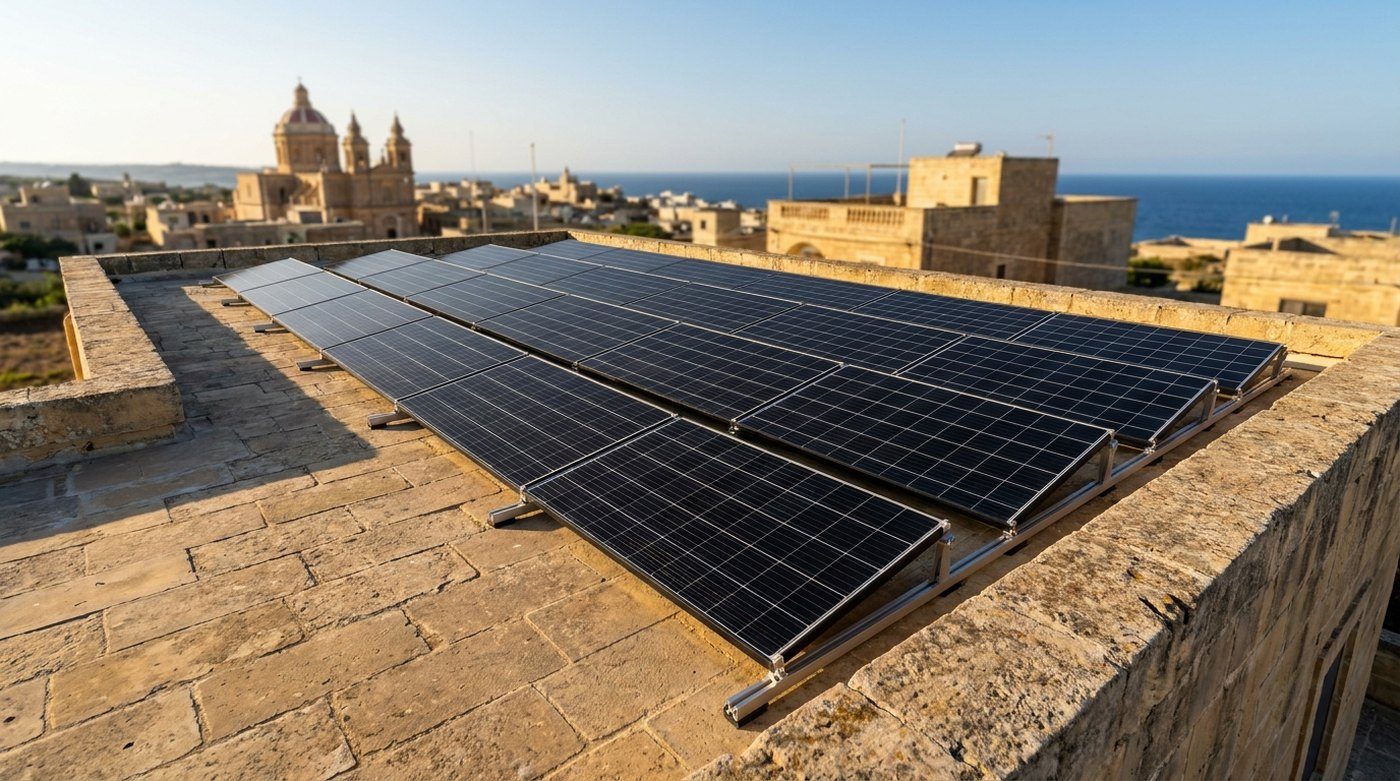
What a battery actually does to your bill
A home battery does not generate electricity. It moves it in time. Electricity your panels make at midday, which you would otherwise export, is held and used in the evening instead.
That means the financial question is narrow and answerable. Every kWh you put through the battery:
- gains you the Enemalta rate you would have paid for that kWh, at your marginal band; and
- loses you the feed-in tariff you would have been paid for exporting it.
If the first number is bigger than the second, the battery earns. If not, it quietly costs you money every day it works.
The numbers for Malta
Enemalta residential rates from 6 February 2026, including 5% VAT, applied cumulatively across the year:
| Annual consumption | Rate (€/kWh) |
|---|---|
| 0–2,000 kWh | 0.1047 |
| 2,001–6,000 kWh | 0.1298 |
| 6,001–10,000 kWh | 0.1607 |
| 10,001–20,000 kWh | 0.3420 |
| Above 20,000 kWh | 0.6076 |
There is also a service charge of €65 a year single-phase and €195 triple-phase, and an eco-reduction for small households. Neither is changed by a battery.
The grant-free feed-in tariff is €0.15/kWh for 20 years for systems under 40 kWp. Set the two against each other:
| Your marginal band | Band rate | Less €0.15 FIT | Gain per kWh stored |
|---|---|---|---|
| 0–2,000 kWh | 0.1047 | −0.0453 | loses money |
| 2,001–6,000 kWh | 0.1298 | −0.0202 | loses money |
| 6,001–10,000 kWh | 0.1607 | +0.0107 | about one cent |
| 10,001–20,000 kWh | 0.3420 | +0.1920 | clear gain |
| Above 20,000 kWh | 0.6076 | +0.4576 | large gain |
This is the part most battery conversations in Malta skip. Because the grant-free tariff is higher than the first two bands, a household importing under 6,000 kWh a year is better off exporting than storing. Not marginally — structurally. Between 6,000 and 10,000 kWh the gain is roughly a cent a kWh, which will not repay hardware. The case only becomes obvious once your annual consumption pushes into the 10,001–20,000 kWh band at €0.3420.
If you took a grant, you are not on the grant-free tariff. The grant-assisted rate was €0.105/kWh in 2025 and the 2026 figure is unconfirmed; on €0.105 the arithmetic shifts in the battery's favour at every band, but you cannot finalise it until the current rate is published.
The band effect works against you as you go
Bands are cumulative over the year, so your marginal rate is set by your annual total, not by what you use in August. That has a consequence people miss: self-consumption pulls you down the bands. If you are at 12,000 kWh and your solar and battery together displace 3,000 kWh of imports, the first 2,000 kWh displaced are worth €0.3420 each and the last 1,000 only €0.1607. The average gain is lower than the headline band rate, and the saving shrinks as the battery succeeds. Size a battery for the top slice of your consumption, not for all of it.
The 2026 grant, and what is left of it
Under the 2026 Renewable Energy Sources Scheme, battery storage attracted 75% of eligible cost, capped at €6,000 per system and €600/kWh. PV with a hybrid inverter attracted 65%, capped at €3,000 per system and €645/kWp. The overall budget was €15.3m, of which €11.2m was for batteries and €4.1m for PV, with applications opening on 20 April 2026 and a 5% uplift for NZIA-compliant kit.
The scheme is closed. Battery options B and C (Part A) closed on 13 July 2026 and the scheme as a whole closed to applications on 12 September 2026. A further round has been announced but has not been detailed — no rates, caps, budget or dates. Do not plan a purchase around terms nobody has published, and be sceptical of any quote that assumes them.
At 75% and €600/kWh, the grant was carrying most of the case for storage at mid-range consumption. Without it, the gap between your band and the tariff has to repay the whole machine.
Retrofitting to an existing array
Adding storage to an existing PV system normally means swapping a string inverter for a hybrid one. An installer summary of the 2026 scheme lists a hybrid-inverter replacement option for systems more than six years old, installed with a battery, at 75% capped at €1,800 and €350/kWp. That is a medium-confidence reading of an installer page rather than the regulator's own text, and the scheme is closed regardless. Budget the retrofit at full cost. Our battery guide covers the sizing side.
Nobody publishes a Malta battery price
There is no neutral, published installed price for home batteries in Malta — no €/kWh, no typical system cost. Anyone quoting one is quoting themselves. So do the division yourself:
- Take the quote and remove anything that is not storage (scaffolding, inverter upgrade, rewiring) so you are pricing the battery alone.
- Divide by usable kWh, not nominal. Ask for both figures in writing.
- Estimate the kWh the battery would cycle in a year — at most one full usable charge a day, and in practice less in winter.
- Multiply by your gain per kWh from the table above.
- Divide the cost by that annual figure. That is your payback, before any degradation.
Then check it against the warranty's own stated throughput. If the warranty expires before the payback, the answer is no.
Generation first, storage second
A battery can only store what the roof makes. PVGIS annual yields: 1,668 kWh/kWp south at 32°, 1,476 flat, 1,376 east, 1,393 west, and 1,677 in Gozo. An east- or west-facing roof produces around 17% less than a good southern pitch, which also spreads output across the day and leaves less surplus to store. On most Maltese roofs, adding panels is cheaper per kWh than adding storage.
Rooftop PV is permitted development under DNO Class 1(iv) of S.L. 552.08 where it is DC15-compliant. For an apartment, the condominium rules govern what you may do on the common roof, and a battery needs a location that works for the block as well as for you. In Gozo, every delivery crosses on the ferry, which shows up in scheduling more than in price.
To see where your consumption sits against the bands, use the calculator on our homepage. For roof layout and orientation, try the free roof planner; for verified installers, CheckYourSolar.
Common questions
- Is the 2026 battery grant still open?
- No. The REWS 2026 Renewable Energy Sources Scheme closed to applications on 12 September 2026, and the battery options (B and C, Part A) closed earlier, on 13 July 2026. While it was open the battery grant was 75% of eligible cost, capped at €6,000 per system and €600/kWh. A further round has been announced but has not been detailed, so no terms, rates or dates can be quoted for it.
- At what level of consumption does a battery start to pay in Malta?
- Compare your marginal Enemalta band with the feed-in tariff you are on. Under the grant-free tariff of €0.15/kWh for 20 years, storing a kWh instead of exporting it gains you the band rate and loses you €0.15. The first two bands (€0.1047 up to 2,000 kWh and €0.1298 up to 6,000 kWh) are below €0.15, so each stored kWh loses money. The 6,001–10,000 kWh band at €0.1607 gains about one cent. Only the 10,001–20,000 kWh band at €0.3420 and the band above 20,000 kWh at €0.6076 produce a clear gain.
- Can I add a battery to a PV system I already have?
- Technically that usually means replacing a string inverter with a hybrid inverter. An installer summary of the 2026 scheme lists a hybrid-inverter replacement option for PV systems more than six years old installed together with a battery, at 75% with caps of €1,800 and €350/kWp. That is an installer's summary rather than the regulator's own wording, and in any case the scheme is closed to applications. Treat the retrofit as a cost you pay in full unless and until the announced further round is detailed.
- How do I tell whether a battery quote is good value?
- No neutral installed battery price for Malta is published, so take your own quote, strip out anything that is not storage, and divide by the usable (not nominal) kWh. That gives you a €/kWh figure you can compare between quotes. Then multiply the kWh the battery would realistically cycle in a year by the gain per kWh from your marginal band, and see how many years the quote takes to come back.
What we could not establish
- No neutral, published 2026 installed battery price for Malta exists — not per kWh, not per system. Any figure you are given is a quote, not a market rate.
- The grant-assisted feed-in tariff was €0.105/kWh in 2025; the 2026 rate is unconfirmed, so grant-assisted households cannot calculate the trade-off precisely.
- The further grant round has been announced but not detailed: no budget, rates, caps, opening date or eligibility are available.
- The sources do not establish battery cycle life, usable-versus-nominal capacity conventions, degradation rates or round-trip efficiency, all of which change the payback.
- No source establishes what share of a typical Maltese household's generation is exported rather than used live, which is the single biggest input to battery sizing.
- Rooftop PV is permitted development under DNO Class 1(iv), S.L. 552.08, where it is DC15-compliant; the sources do not establish how battery enclosures are treated, nor how condominium rules apply to siting one in an apartment block.
- The hybrid-inverter replacement terms come from an installer page, not from REWS directly, and are medium confidence.
Sources
- Residential electricity tariffs — Enemalta · read 2026-10-16
- New REWS incentives to boost solar and battery storage in homes — TVM News · read 2026-10-16
- 2026 Renewable Energy Sources Scheme — Regulator for Energy and Water Services (REWS) · read 2026-10-16
- Government grants — Virtue Solaris (installer) · read 2026-10-16
Drafted with Claude — claude-opus-5, then read, corrected and approved by Neil Bennett before publication. We do not publish anything a person has not read.
Want this costed properly?
The calculator gives you a figure in a minute. A site visit gives you a fixed price.
Book a free survey