
East-west, south or flat: which way should panels face?
South at about 30-32° is the best-yielding direction in Malta, but on a flat roof the frame decides the direction and the roof decides how many panels fit. Here are the PVGIS figures and the honest trade-offs.
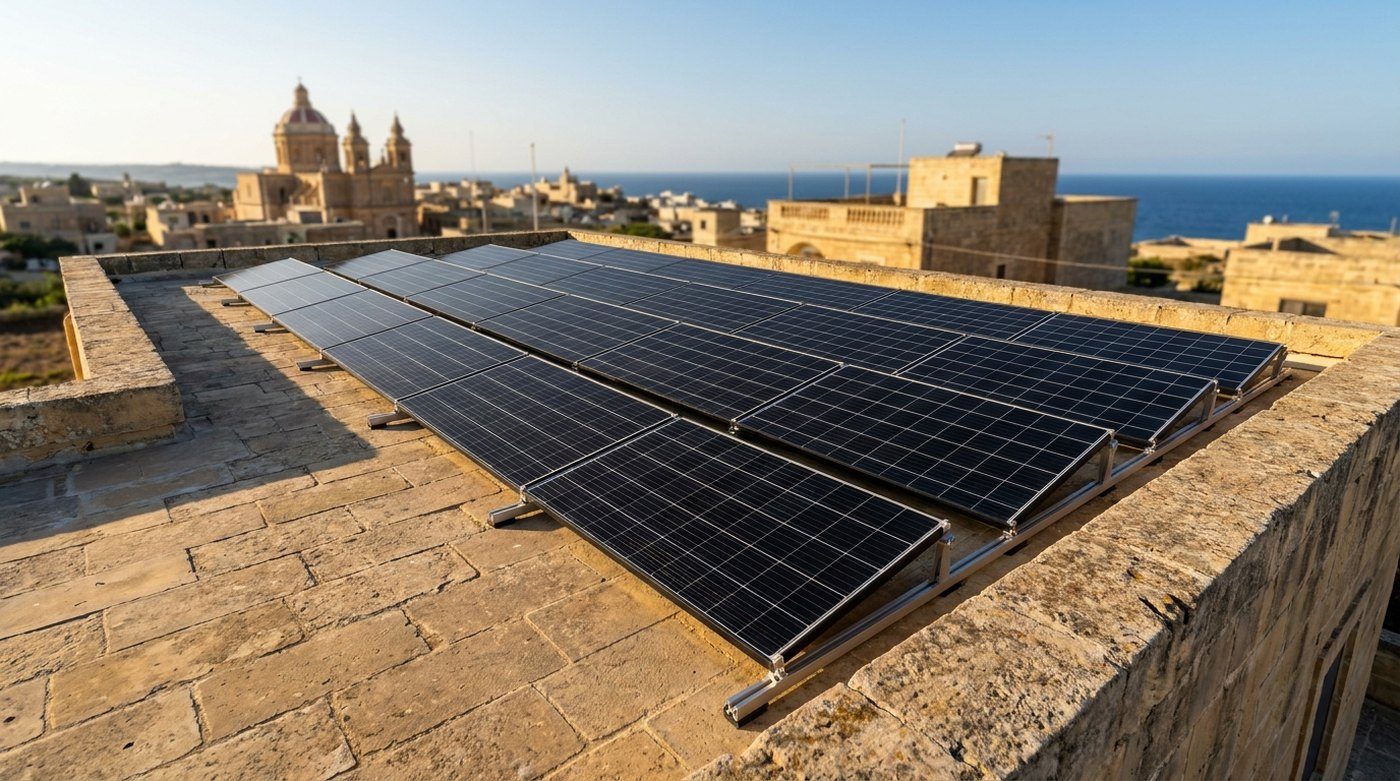
Most houses in Malta and Gozo have a flat roof. That changes the orientation question completely. On a pitched British roof the roof decides which way the panels face and you live with it. Here, the mounting frame decides, which means somebody has to make a choice — and the choice is usually a trade-off between how much each panel produces and how many panels fit at all.
The numbers
These are from PVGIS v5.3 PVcalc (SARAH3 irradiation database, 14% system losses), run for Malta on 16 October 2026.
| Orientation and tilt | kWh per kWp per year | Against south 32° |
|---|---|---|
| South, 32° (PVGIS optimum) | 1,668 | — |
| South, 30° | 1,667 | effectively identical |
| Flat, 0° | 1,476 | -11% |
| West, 30° | 1,393 | -16% |
| East, 30° | 1,376 | -17% |
| Gozo, optimum | 1,677 | slightly higher |
Two things fall out of that table immediately.
First, the optimum is broad. South at 30° and south at 32° differ by one kilowatt-hour per kilowatt per year. Anyone who tells you a system must be set at an exact degree is selling precision that the irradiation data does not reward. Anything in that south-facing, roughly 30° region is the top of the curve.
Second, the penalties are smaller than people expect. Flat mounting loses 11%. East or west at 30° loses 16-17%. These are real losses and they compound over 20 years, but none of them turns a working roof into a bad one.
Why flat is not the obvious loser
Comparing 1,476 against 1,668 compares one kilowatt against one kilowatt. That is the wrong comparison for a flat Maltese roof, because tilted rows shade each other. Raise the panels to 30° and you have to leave a gap behind each row so the winter sun still reaches the next one. Lay them flat or near-flat and the rows can sit much closer together.
So the question is not "how much does each kilowatt make" but "how many kilowatt-hours comes off this roof in a year". A flat layout that fits noticeably more panels can beat a tilted layout that fits fewer, even at 1,476 against 1,668. On a small terraced roof already carrying two water tanks, a solar water heater and a washing line, the fitted capacity difference can be decisive.
Our sources do not give a square-metres-per-kilowatt figure or a row-spacing formula, and we are not going to invent one. That calculation has to be done on your actual roof, with your actual obstructions, which is what the free roof planner is for.
Flat mounting has two further practical consequences worth naming. Panels lying flat collect more dust and the autumn rain does not sheet off them as readily, so they need washing more often. And flat panels sit lower, which matters for the planning point below.
East-west: when it earns its 16%
An east-west split array puts half the panels facing sunrise and half facing sunset, usually on a shallow A-frame. Per kilowatt it is the weakest of the options in the table. It gets chosen anyway for three honest reasons:
- Density. East-west rows nest together with little or no shading gap, so more panels can go on the same roof than a south-facing tilted layout allows.
- Roof geometry. Some roofs are long east-west and narrow north-south. A south-facing tilted layout wastes the shape; an east-west one does not.
- Output shape. The generation curve is flatter and wider rather than a midday peak. Whether that is worth anything to you depends on when you actually use electricity and on what your exported units are paid — and no source we are using quantifies the self-consumption share of a Maltese household, so we will not pretend to.
What east-west should never be chosen for is a vague claim that it "beats south". It does not. It produces 16-17% less per kilowatt and that is settled by the data.
North
Nobody should be putting panels on a north-facing slope in Malta if there is any alternative, and on a flat roof there is never a reason to. PVGIS does not need to be consulted for that one.
The parapet rule, and what planning actually says
The REWS Manual of Procedures (version 1, 24 November 2025) is clear that rooftop PV is permitted development under DNO Class 1(iv) of S.L. 552.08, and that no notification is required where the installation is DC15-compliant (guidance G26). It must not exceed the roof height limit.
The exception is the one that catches buyers of character property. For scheduled buildings, and for buildings over 75 years old in conservation areas, the installation must stay within the building envelope and must not rise above the parapet.
That is an orientation constraint disguised as a heritage rule. A 30° south-facing frame stands proud; on a townhouse in Valletta, Mdina, the Three Cities or a Gozo village core with a low parapet, that frame may simply not be lawful. A flat or very shallow layout that stays below the parapet line may be the only compliant option — which is another reason the 11% flat penalty is worth understanding properly rather than dismissing.
If you are in an apartment, the roof is almost certainly governed by the condominium deed and the other owners' rights over it, and no planning class overrides that.
What the direction is worth, arithmetically
The grant-free feed-in tariff is €0.15/kWh for 20 years for systems under 40 kWp. Taking that rate at face value and applying it to the PVGIS yields, one kilowatt of capacity generates units with a gross value of €250.20 a year facing south at 32°, €221.40 flat, €208.95 facing west and €206.40 facing east. That is simple multiplication on a published rate, not a savings estimate: it assumes every unit is exported, which no household does.
Units you use yourself displace Enemalta's residential bands, which including 5% VAT run 0.1047 / 0.1298 / 0.1607 / 0.3420 / 0.6076 €/kWh at the 2,000 / 6,000 / 10,000 / 20,000 kWh thresholds. A heavy-consuming villa displacing units at the top band is in a different economic position from a flat sitting in the first band, and orientation matters correspondingly more or less. The sourced calculator on the homepage does that part with your consumption rather than an average.
On grants: the 2026 REWS RES grant closed to applications on 12 September 2026, with battery options closing 13 July 2026. A further round has been announced but not detailed. The grant-assisted feed-in tariff was €0.105/kWh in 2025 and the 2026 rate is unconfirmed. Do not let an orientation decision wait on a scheme whose terms nobody has published.
A short order of operations
- Measure what the roof can actually hold, obstructions included, before arguing about degrees.
- Check whether the building is scheduled or over 75 years old in a conservation area — that may decide the tilt for you.
- Compare total annual kWh from competing layouts, not kWh per kWp.
- Confirm the installation is DC15-compliant so it stays inside permitted development.
- Only then consider whether storage changes the picture — StoreYourSolar covers that, and no Malta battery price is published anywhere we can verify.
Quotes that disagree about orientation are normal and often both defensible. Quotes that disagree about the PVGIS numbers are not. Installers listed in the verified installer directory are CheckYourTraders-verified; that verifies the trader, not the design, so the arithmetic above is still yours to check.
Common questions
- How much output do I lose facing east or west instead of south in Malta?
- PVGIS v5.3 (SARAH3, 14% system losses), run for Malta on 16 October 2026, gives 1,668 kWh/kWp/yr for south at 32° (the optimum), 1,393 for west at 30° (-16%) and 1,376 for east at 30° (-17%). An east-west split array therefore produces roughly a sixth less per kilowatt installed than a south-facing one of the same size.
- Is it worth tilting panels on a flat Maltese roof?
- Flat (0°) mounting yields 1,476 kWh/kWp/yr against 1,668 for south at 32°, an 11% shortfall. Tilting recovers that 11% per kilowatt, but tilted rows must be spaced apart so they do not shade each other, so fewer kilowatts may fit on the same roof. The right comparison is total annual kWh from the roof, not kWh per kWp.
- Do I need planning permission to change the direction my panels face?
- Rooftop PV is permitted development under DNO Class 1(iv) of S.L. 552.08, and the REWS Manual of Procedures (version 1, 24 November 2025) states that no notification is required where the installation is DC15-compliant (guidance G26). It must not go above the roof height limit. Scheduled buildings, and buildings over 75 years old in conservation areas, must keep the installation within the building envelope and not above the parapet.
- Does Gozo get more sun than Malta?
- Marginally. The same PVGIS run gives 1,677 kWh/kWp/yr at the Gozo optimum against 1,668 for Malta. The difference is not a reason to choose or reject a system; the practical Gozo difference is logistical, since every delivery crosses on the ferry.
What we could not establish
- There is no neutral published installed price per kWp for Malta in 2026, and no published Malta battery price — so the cost side of an orientation trade-off cannot be stated as fact here.
- PVGIS gives yield per kWp but no m² per kWp and no row-spacing rule, so the number of panels a given flat roof holds at a given tilt cannot be derived from these sources.
- No source here establishes what share of generation a Maltese household self-consumes, so claims that east-west 'matches demand better' cannot be quantified from the evidence available.
- PVGIS models a clear horizon at the coordinates queried; it does not account for your water tanks, lift room, washing lines or the neighbour's parapet.
- The 2026 REWS RES grant closed to applications on 12 September 2026 (battery options 13 July 2026). A further round has been announced but not detailed, so eligibility, rates and whether orientation affects it are unknown.
- The grant-assisted feed-in tariff was €0.105/kWh in 2025; the 2026 rate is unconfirmed.
Sources
- PVGIS v5.3 PVcalc (SARAH3, 14% losses) — European Commission Joint Research Centre · read 2026-10-16
- Manual of Procedures, version 1 (24 November 2025) — REWS · read 2026-10-16
Drafted with Claude — claude-opus-5, then read, corrected and approved by Neil Bennett before publication. We do not publish anything a person has not read.
Want this costed properly?
The calculator gives you a figure in a minute. A site visit gives you a fixed price.
Book a free survey