
How much does a 3-5 kWp solar system produce in Malta?
Worked annual yields for small domestic systems, taken from a single PVGIS v5.3 run, plus what those kilowatt-hours are worth against Enemalta's cumulative residential bands.
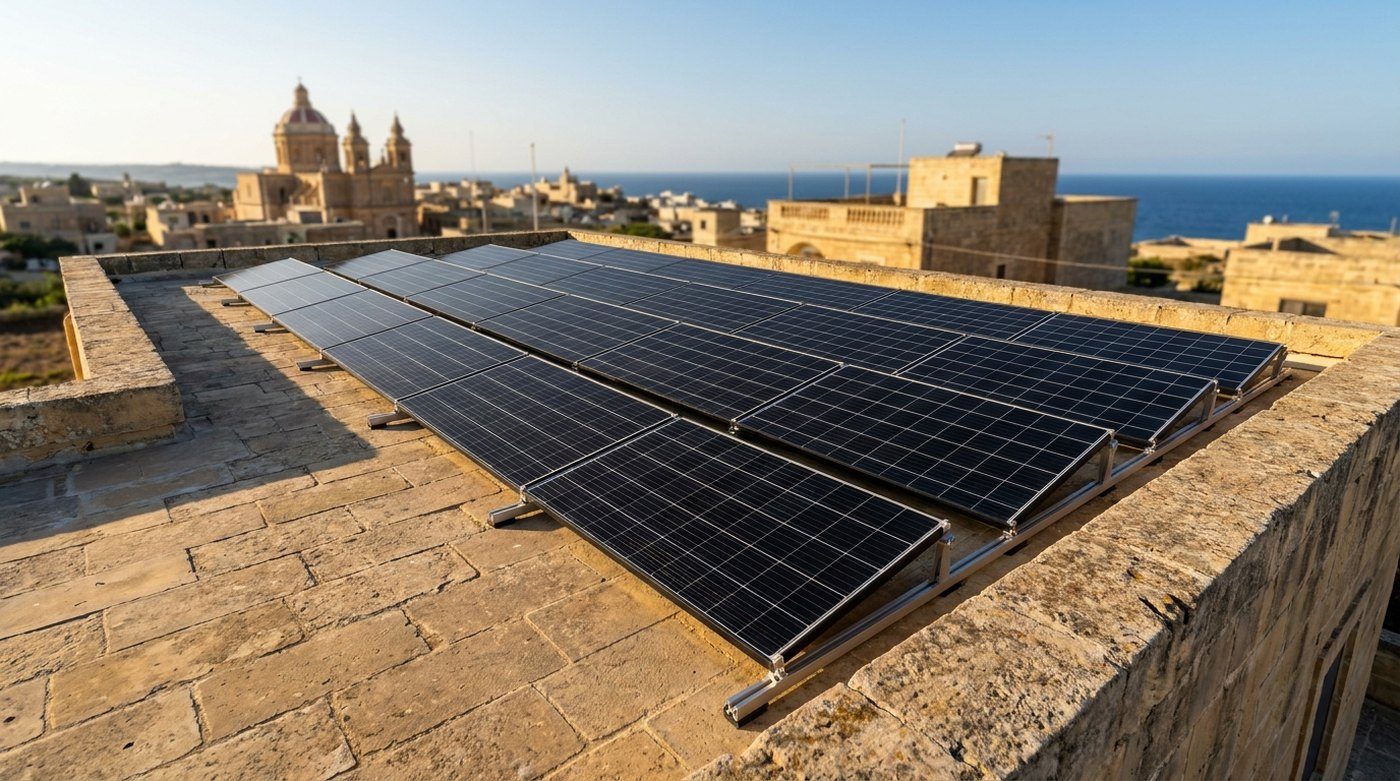
Most questions about solar in Malta are really one question: how many kilowatt-hours will come off the roof, and what are they worth. The first half is arithmetic. The second half depends on how much electricity your household already burns, because Enemalta's residential tariff is a cumulative ladder and solar takes units off the top rung first.
The only number you need to multiply
PVGIS v5.3, run on 16 October 2026 using the SARAH3 database with the standard 14 per cent system losses, gives these specific yields for Malta:
- South, 32 degrees (optimal): 1,668 kWh per kWp per year
- South, 30 degrees: 1,667
- Flat (no tilt): 1,476 — about 11 per cent below optimal
- East, 30 degrees: 1,376 — about 17 per cent below optimal
- West, 30 degrees: 1,393 — about 16 per cent below optimal
- Gozo, optimal angle: 1,677
Pick the line that matches your roof, multiply by your system size in kWp, and you have your modelled annual output. That is the whole method.
Two things worth noticing straight away. First, tilt barely matters: 30 degrees and 32 degrees differ by one kilowatt-hour per kWp. Second, orientation matters far more than most people expect — an east-facing pitch gives up roughly a sixth of the year's production against south.
The table
| System size | South 32° | Flat | East 30° | West 30° | Gozo optimal |
|---|---|---|---|---|---|
| 3 kWp | 5,000 | 4,430 | 4,130 | 4,180 | 5,030 |
| 3.5 kWp | 5,840 | 5,170 | 4,820 | 4,880 | 5,870 |
| 4 kWp | 6,670 | 5,900 | 5,500 | 5,570 | 6,710 |
| 5 kWp | 8,340 | 7,380 | 6,880 | 6,970 | 8,390 |
All figures in kWh per year, rounded to the nearest ten. These are model estimates from a single PVGIS run, not measured output and not a guarantee. They assume a clean, unshaded array at the stated tilt and orientation.
The 3.5 kWp row is there because that is reported as the average domestic system size in Malta — a figure seen in search results for the NSO's PV statistics page rather than verified on the page itself, so treat it as an indication of what neighbours have rather than a hard benchmark. The same source gives national installed capacity as 268,016.5 kWp.
Where that output lands on your bill
Enemalta's residential rates as at 6 February 2026, including 5 per cent VAT, are cumulative over the billing year:
| Annual consumption | Rate (€/kWh) |
|---|---|
| 0–2,000 kWh | 0.1047 |
| 2,001–6,000 kWh | 0.1298 |
| 6,001–10,000 kWh | 0.1607 |
| 10,001–20,000 kWh | 0.3420 |
| Above 20,000 kWh | 0.6076 |
There is also a fixed service charge of €65 a year single-phase, €195 triple-phase, and an eco-reduction for small households.
Because the bands are cumulative, a kilowatt-hour you do not buy is worth whatever your top band costs, not your average rate. That is the single most important thing to understand about solar economics here, and it means two identical 4 kWp systems can be worth wildly different amounts of money.
Three worked cases, assuming for illustration that the units are consumed in the house rather than exported:
- A household using 4,500 kWh a year. Everything above 2,000 kWh sits in the 0.1298 band. Displacing 2,500 kWh saves 2,500 × 0.1298 = €324.50. You cannot save more than that from band displacement, because the remaining 2,000 kWh are only worth 0.1047 each.
- A household using 9,000 kWh a year. The top 3,000 kWh sit at 0.1607. Displacing them saves €482.10, after which further displacement drops into the 0.1298 band.
- A household using 12,000 kWh a year — a pool pump, a few air conditioners, maybe an EV. The first 2,000 kWh displaced come off the 0.3420 band and are worth €684 on their own. The next 4,000 come off at 0.1607, worth €642.80.
The ladder is steep at the top. The jump from 0.1607 to 0.3420 more than doubles the value of a displaced unit, which is why heavy consumers see a very different return from modest ones even with the same roof and the same array.
Generation is not the same as saving
The table above is production. Savings are a different quantity, and the difference is timing. Solar peaks in the middle of the day; many households peak in the evening. Units you generate but do not use at the moment of generation are exported and paid at the feed-in tariff rather than deducted from your consumption at the band rate above.
No source used here establishes what proportion of a Maltese household's generation is typically self-consumed, so this article does not give one — and you should treat any figure quoted to you as a sales assumption unless it comes with the household data behind it. A battery changes that split, which is the subject of our battery guide. Our savings and payback calculator handles the self-consumption and export arithmetic with the inputs made explicit; the battery and sizing tabs open directly.
On grants: the 2026 REWS RES grant closed to applications on 12 September 2026, with battery options closing on 13 July 2026. A further round has been announced but has not been detailed — no rates, caps or dates are published, and nobody can tell you what it will contain.
Roof realities in Malta and Gozo
Rooftop PV is permitted development under Class 1(iv) of the Development Notification Order, S.L. 552.08, provided the installation is DC15-compliant. That removes a planning step that trips people up elsewhere, but it does not remove the other constraints.
Most Maltese roofs are flat, which is why the 1,476 kWh/kWp line matters so much. A flat array loses about 11 per cent against optimal; tilt frames recover that but take more roof area per kWp because of inter-row shading, so on a small terraced roof the flat figure may be the realistic one. Apartment installations are bound by condominium rules on common roof space regardless of what the planning law permits. And in Gozo — where the modelled yield is a negligible nine kilowatt-hours per kWp higher — every panel, inverter and frame crosses on the ferry, which shows up in scheduling rather than in production.
If you want the array laid out on your actual roof outline rather than estimated from a table, our free roof planner, SpecYourSolar, does that, and a free roof survey checks the things a model cannot see. How the installers doing that work are verified is set out at CheckYourSolar.
Common questions
- How much electricity does a 3.5 kWp system produce in Malta?
- On a south-facing roof at 32 degrees, PVGIS v5.3 models 1,668 kWh per kWp per year, so 3.5 kWp gives roughly 5,840 kWh. Flat on a roof with no tilt frame it is about 5,170 kWh, east-facing at 30 degrees about 4,820 kWh, west-facing at 30 degrees about 4,880 kWh, and at Gozo's optimal angle about 5,870 kWh. These are model estimates, not guarantees.
- Is a west-facing roof worth doing in Malta?
- In the PVGIS run, west at 30 degrees gives 1,393 kWh/kWp against 1,668 for south at 32 degrees — about 16 per cent less. East at 30 degrees gives 1,376, about 17 per cent less. That is a real loss but not a disqualifying one; whether it stacks up depends on your consumption and your installed cost, neither of which this model covers.
- Does Gozo produce more than Malta?
- Marginally, in this model. The Gozo optimal-angle figure is 1,677 kWh/kWp against 1,668 for Malta at south 32 degrees — about half a per cent. It is not a reason to choose or reject a site. Delivery logistics across the ferry are a more practical difference than irradiance.
- Will a 4 kWp system cover my whole electricity bill?
- Not in the way most people mean. A 4 kWp south-facing array is modelled at about 6,670 kWh a year, which may match or exceed a household's annual consumption on paper, but generation and consumption do not happen at the same times of day. Units you export are paid at the feed-in tariff rather than saving you the band rate you would otherwise have paid. The fixed service charge — 65 euro a year single-phase, 195 euro triple-phase — stays on the bill either way.
What we could not establish
- PVGIS models a clean, unshaded array at a stated tilt. It does not account for your parapet, water tanks, washing lines, neighbouring blocks or dust accumulation, and no source here quantifies those losses for a specific Maltese roof.
- Panel degradation over time is not established by any source used here, so no year-10 or year-25 output figure is given.
- The split between self-consumed and exported units depends entirely on household behaviour. None of these sources establishes a typical Maltese self-consumption share, so this article does not state one.
- There is no neutral published installed price per kWp for Malta in 2026, and no published Maltese battery price. Payback cannot be calculated from the sources here alone.
- The 2026 REWS RES grant closed to applications on 12 September 2026 (battery options 13 July 2026). A further round has been announced but not detailed — rates, caps and opening dates are not published.
- The grant-free feed-in tariff is 0.15 euro per kWh for 20 years for systems under 40 kWp. The grant-assisted rate was 0.105 euro per kWh in 2025; the 2026 grant-assisted rate is unconfirmed.
- Enemalta's published band table notes an eco-reduction for small households but the sources used here do not set out the eligibility thresholds.
- The 3.5 kWp average domestic system size is from an NSO page seen in search results only and has not been verified on the page itself.
Sources
- PVGIS v5.3 PVcalc (SARAH3, 14% losses) — European Commission Joint Research Centre · read 2026-10-16
- Renewable energy from photovoltaic panels (PVs): 2025 — National Statistics Office Malta · read 2026-10-16
- Residential electricity tariffs — Enemalta · read 2026-10-16
Drafted with Claude — claude-opus-5, then read, corrected and approved by Neil Bennett before publication. We do not publish anything a person has not read.
Want this costed properly?
The calculator gives you a figure in a minute. A site visit gives you a fixed price.
Book a free survey