
Cleaning solar panels in Malta: dust, salt and output
Dust and sea salt are the most asked-about maintenance问题 in Malta, yet no Maltese source sets a cleaning interval or quantifies what dirt costs you. This piece says so plainly, then shows the one check you can actually run on sourced data: your system's annual output against the PVGIS figure for its orientation.
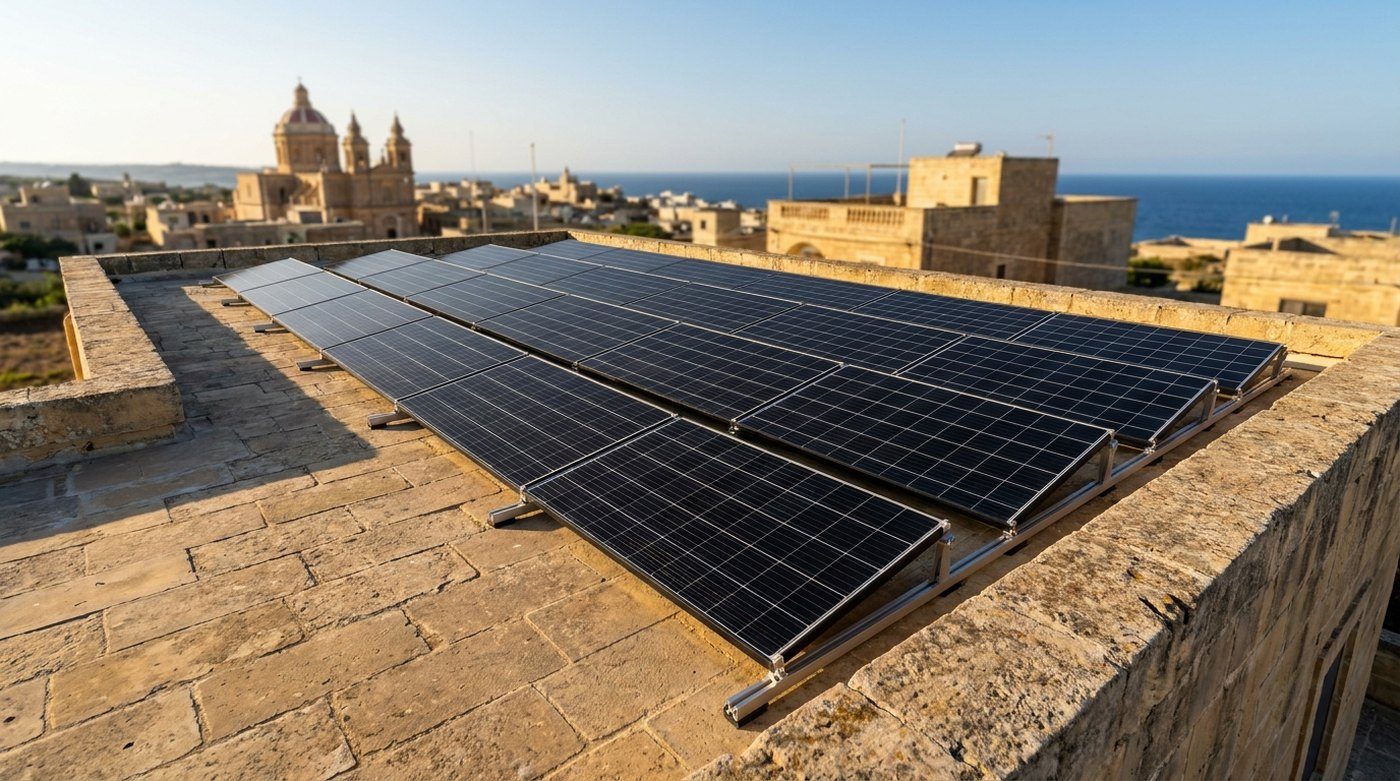
Dust from the sirocco, salt carried off the sea, and a rain pattern that does nothing useful between May and September — Malta looks like a place where panel cleaning should matter a great deal. It probably does. The problem is that nobody has published a Maltese number for it.
What nobody publishes
There is no Maltese soiling study. No regulator, utility or research body publishes a cleaning interval for Malta or Gozo, and none publishes how much output dirt actually costs an array here. There are no published cleaning prices either. Anything you read that gives you a percentage loss or a "clean every X months" rule for Malta specifically is someone's guess, an overseas figure borrowed wholesale, or a sales line.
This matters more than it sounds. A cleaning contract sold on an invented loss figure is impossible to evaluate: you cannot tell whether it pays for itself, because the thing it is supposed to recover has never been measured locally. Whether a coastal roof in Marsaxlokk soils faster than an inland one in Rabat is, as far as published sources go, unknown.
So this article does not tell you how often to clean. It tells you how to find out whether you have a problem at all.
The one check you can run on sourced data
PVGIS, run by the European Commission's Joint Research Centre, models annual output per kilowatt-peak for a given location and orientation. Run on 16 October 2026 for Malta, with the standard 14% system loss assumption, it gives:
| Orientation | kWh per kWp per year | Versus optimal |
|---|---|---|
| South, 32° (optimal) | 1,668 | — |
| South, 30° | 1,667 | −0.1% |
| Flat | 1,476 | −11% |
| East, 30° | 1,376 | −17% |
| West, 30° | 1,393 | −16% |
| Gozo, optimal | 1,677 | +0.5% |
The check is arithmetic:
- Find your system size in kWp — it is on your installation paperwork and usually on the inverter commissioning sheet.
- Multiply by the figure above for your roof's orientation.
- Compare with the kWh your inverter app or generation meter recorded over a full twelve months.
A 4 kWp south-facing array at 32° benchmarks at roughly 6,672 kWh a year. The same 4 kWp pointing east benchmarks at about 5,504 kWh. If your east-facing system is producing 5,400 kWh, you do not have a dirt problem — you have an east-facing roof, which the −17% in that table already accounts for.
Two cautions. PVGIS is a model of a typical year, not a forecast of yours; weather varies. And the 14% loss assumption is generic — it is not a Malta soiling measurement, so you cannot work backwards from it to isolate dust. Use the comparison to spot something large, not to audit a few percent.
When the gap is big
If you are well below the benchmark — the kind of gap that survives any reasonable allowance for a poor year and for panels that are no longer new — dirt is one candidate among several, and not the first one to check because it is the only one you can see.
- Shading. A water tank, a new storey on the neighbouring property, a TV aerial, a parapet wall. On a string inverter without optimisers, one shaded panel can drag a whole string.
- A dead string or a disconnected MPPT input. Compare the inverter's per-string figures if it reports them. One string at zero is unmistakable.
- Inverter faults or derating. Check the fault log, and check that nothing has been stacked against the inverter's ventilation.
- A tripped AC breaker. Systems have run at zero for weeks because nobody looked at the consumer unit.
- Soiling. Visible, even, grey-brown film across all panels — or bird droppings and cement dust concentrated in patches, which is the case where a localised deposit does disproportionate damage.
The point of the benchmark is that it turns "I think my panels are dirty" into a number you can act on, and it will often tell you the problem is something else entirely.
Why output is worth money
What a missing kWh costs you depends on whether it would have been used in the house or exported.
Enemalta's residential bands, including 5% VAT, are €0.1047/kWh to 2,000 kWh, €0.1298 to 6,000, €0.1607 to 10,000, €0.3420 to 20,000 and €0.6076 above that. Self-consumed generation displaces units at your top band — which is why households that run air conditioning hard and reach the upper bands lose the most from an underperforming system.
Exported units are paid at the feed-in tariff. The grant-free rate is €0.15/kWh for 20 years for systems under 40 kWp. The grant-assisted rate was €0.105/kWh in 2025; the 2026 rate is unconfirmed. Under the 2026 REWS scheme the grant and the grant-free tariff were mutually exclusive — you took one or the other. Our savings and payback calculator works through what that means for a given household, and the battery guide covers the self-consumption side.
Keep the records
The 2026 REWS RES scheme required applicants to keep the installation for five years and provided for a 10-year installer warranty, with Part A submitted before purchase, an offer letter valid eight months, and Part B lodged afterwards with the fiscal receipt. That scheme closed to applications on 12 September 2026, with battery options closing on 13 July 2026; a further round was announced but has not been detailed, so its terms are unknown.
If you hold a 2026 grant, the five-year keep rule and the 10-year warranty are both reasons to keep a tidy file: the fiscal receipt, the Part B submission, the commissioning sheet with the kWp rating, and an annual output figure. A warranty conversation goes very differently when you can show three years of generation data against the PVGIS benchmark.
Practicalities on a Maltese roof
Rooftop PV is permitted development under DNO Class 1(iv), S.L. 552.08, where the installation complies with DC15. Planning status, though, says nothing about who may walk on your roof. In an apartment block, access to the roof and any works on common parts are governed by the condominium rules, and those bind regardless of what the planning regulations allow — settle that before scheduling anyone.
Know who is responsible for what before anyone goes up with a brush.
In Gozo, every callout and every replacement part crosses on the ferry. That shows up as lead time rather than as a published surcharge, and it is worth asking about when you compare maintenance arrangements.
Finally: nobody publishes guidance on water quality for panel washing in Malta either, so we are not going to invent any. If you are planning a new system rather than diagnosing an existing one, SpecYourSolar sizes a roof, CheckYourSolar explains how our installers are verified, and a free roof survey covers orientation and shading properly — which is where most large output gaps are actually decided.
Common questions
- How often should solar panels be cleaned in Malta?
- No Maltese source publishes a cleaning interval. There is no local soiling study, no regulator guidance and no published figure for how much dust or sea salt costs a Maltese array. Rather than follow a number someone invented, compare your system's annual output in kWh with the PVGIS figure for its orientation (south 32° 1,668 kWh/kWp/yr, flat 1,476, east 1,376, west 1,393, Gozo optimal 1,677) and investigate if there is a large shortfall.
- How do I tell whether dirt is costing me output?
- Take your system size in kWp, multiply it by the PVGIS figure for your roof's orientation, and compare with the kWh your inverter or meter recorded over a full twelve months. A small gap tells you nothing useful. A large one is worth investigating — and dirt is only one of several possible causes, alongside shading, a dead string, an inverter fault or a tripped breaker.
- Do cleaning or maintenance works need a planning permit?
- Rooftop PV is permitted development under DNO Class 1(iv), S.L. 552.08, provided the installation complies with DC15. That covers the installation itself. If you live in an apartment, roof access and works on common parts are governed by your condominium rules regardless of planning status, so check those before anyone goes up.
- Does maintenance affect my grant or warranty?
- The 2026 REWS RES scheme required the installation to be kept for five years and came with a 10-year installer warranty. Note that the 2026 scheme closed to applications on 12 September 2026 (battery options closed 13 July 2026); a further round was announced but has not been detailed. If you hold a 2026 grant, keeping your fiscal receipt, Part B paperwork and output records for the five-year period is sensible. Warranty terms beyond the 10-year installer warranty stated in the guidelines are a matter for your own contract.
What we could not establish
- No Maltese soiling or cleaning study exists — nothing establishes a cleaning interval for Malta or Gozo.
- No published figure for how much output dust or sea salt costs a Maltese array, in percentage or kWh terms.
- No published prices for panel cleaning in Malta, so none are quoted here.
- Whether coastal arrays soil faster than inland ones in Malta is not established by any source we could find.
- PVGIS applies a generic 14% system loss assumption; it is not a Malta-specific soiling measurement and cannot be used to isolate dirt.
- No published panel degradation rate for Maltese conditions, so expected output in year 10 versus year 1 is not establishable here.
- The further round of the REWS RES scheme was announced but not detailed — eligibility, rates and dates are unpublished.
- The grant-assisted feed-in tariff was €0.105/kWh in 2025; the 2026 rate is unconfirmed.
Sources
- PVGIS v5.3 PVcalc (SARAH3, 14% losses) — European Commission Joint Research Centre · read 2026-10-16
- Guidelines for Applicants — 2026 RES scheme — REWS · read 2026-10-16
Drafted with Claude — claude-opus-5, then read, corrected and approved by Neil Bennett before publication. We do not publish anything a person has not read.
Want this costed properly?
The calculator gives you a figure in a minute. A site visit gives you a fixed price.
Book a free survey