
Choosing a solar installer in Malta: the questions to ask
A practical list of questions to put to any installer before you sign, with the rules each question comes from — warranties, REWS-registered equipment, expected yield you can check against PVGIS, DC15 compliance and who files the paperwork.
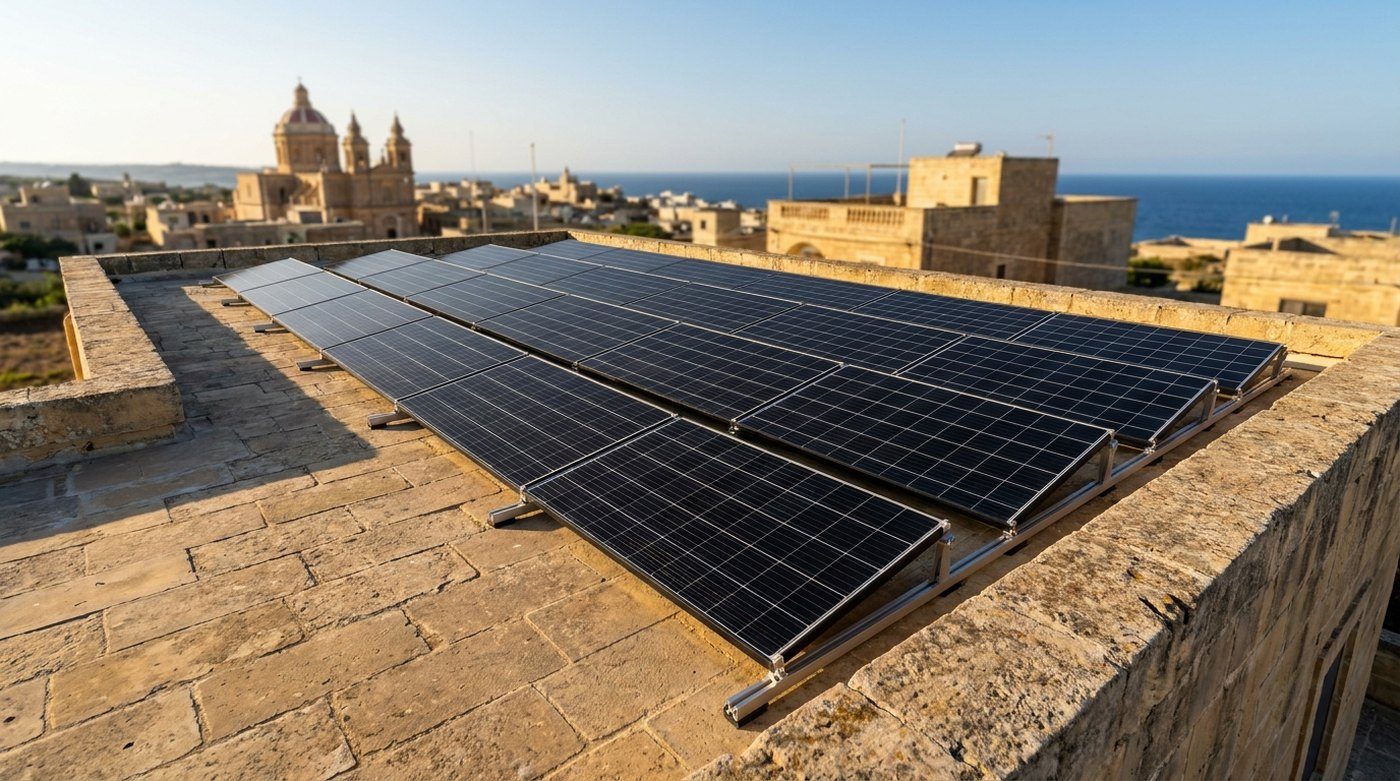
Most solar buying advice is written as market claims — what things cost, how much you will save, who is best. This article is written as questions instead, because the questions are checkable and the claims mostly are not. Take the list to any quote, including ours.
First, the state of play
The 2026 REWS RES grant closed to applications on 12 September 2026, with the battery options closing earlier, on 13 July 2026. A further round has been announced but not detailed — no rates, no caps, no opening date. Every number anyone quotes you for "the grant" right now is either the closed 2026 round or a guess.
That matters for the questions below because the 2026 scheme set several conditions that are worth keeping as your own standard whether or not a grant applies: REWS-registered equipment, a grid-connected system, PV above 1 kW and batteries above 2 kWh, the installation kept in place for five years, and a 10-year installer warranty.
The other fork in the road is the feed-in tariff. The grant-free tariff is €0.15/kWh for 20 years for systems under 40 kWp. The grant-assisted tariff was €0.105/kWh for 20 years in 2025; the 2026 rate is not confirmed. Under the 2026 scheme the grant and the grant-free tariff were mutually exclusive. Ask any installer to show you the arithmetic both ways for your roof before you commit — our savings and payback calculator does the same sum.
The questions
1. Is every item of equipment REWS-registered?
The 2026 scheme required it, and any future round is likely to. Ask for make and model of panels, inverter and (if fitted) battery, in writing, on the quote — not "or equivalent". If a model is substituted later and the replacement is not registered, you can lose eligibility through no fault of your own.
2. What warranties do I get, in writing, and from whom?
Four separate things, four separate documents:
- Panel product warranty and performance warranty — these are different lengths.
- Inverter warranty, and whether an extension was bought or merely offered.
- Battery warranty, including the throughput or cycle condition that voids it.
- Workmanship — the 2026 grant required a 10-year installer warranty. Ask whether theirs is 10 years, what it covers (labour, re-roofing, scaffolding on return visits), and who honours it if the company stops trading.
3. What annual yield are you predicting, and how did you get it?
Ask for kWh per kWp per year, not a bill-saving percentage. Then check it. PVGIS v5.3 (SARAH3 model, 14% system losses), run on 16 October 2026 for Malta, gives:
| Orientation and tilt | kWh/kWp/yr | Versus optimum |
|---|---|---|
| South, 32° (optimal) | 1,668 | — |
| South, 30° | 1,667 | −0.1% |
| Flat | 1,476 | −11% |
| East, 30° | 1,376 | −17% |
| West, 30° | 1,393 | −16% |
| Gozo, optimal | 1,677 | +0.5% |
A 4 kWp array on an optimally tilted south-facing Malta roof is therefore modelled at about 6,670 kWh a year. If a quote promises substantially more than the PVGIS figure for your orientation, ask what assumption is doing the work. If it promises less, that may be honest — shading, soiling, a tight string layout — but it should be explained, not buried.
4. How did you assess shading, and when?
Malta's roofs are crowded: water tanks, washing lines, lift overruns, the neighbour's new third floor. Ask whether anyone stood on the roof, at what time of day and year, and whether the quote accounts for winter morning shade from an adjacent block. Ask how the modules are strung, and whether optimisers or microinverters are proposed and why. A shading answer that consists of a satellite screenshot is not an assessment. You can sketch your own roof first with SpecYourSolar, our free roof planner, and bring that to the conversation.
5. Does the installation comply with DC15 — and does the parapet rule apply to me?
Rooftop PV is permitted development under Class 1(iv) of the Development Notification Order (S.L. 552.08). No notification is required where the installation is DC15-compliant (guidance G26) and does not exceed the roof height limit. But if your property is a scheduled building, or is over 75 years old and within a conservation area, the installation must sit within the building envelope and not above the parapet — which can rule out tilted frames on a flat roof and push you towards a flat or low-profile layout at 1,476 kWh/kWp instead of 1,668. Ask the installer to state, in writing, which category your building falls into and how the design satisfies it. Townhouses in Valletta, the Three Cities, Mdina and the older village cores are the obvious cases, but conservation-area boundaries are wider than people expect.
6. Who does the paperwork — the grid connection and the feed-in tariff?
Ask explicitly: who applies for the grid connection, who submits the tariff paperwork, who is named on the forms, and what happens if something is rejected. If a grant round is open when you buy, the 2026 process ran in a fixed order — Part A before you purchase anything, then an offer letter valid for eight months, then installation, then Part B with the fiscal receipt. Buying first and applying afterwards disqualified you. Ask whether the installer manages that sequence or simply hands you a folder.
7. Am I eligible at all?
The 2026 scheme was for Malta residents aged 18 or over who own the property (or hold it under emphyteusis or a long lease), with a bill on a residential tariff within the last 12 months. Landlords and businesses were excluded, as was anyone who had received a grant for a similar system since 2010.
8. If this is an apartment, who owns the roof?
The common roof of a block is governed by the condominium, not by whichever flat is highest. Ask the installer whether they have written condominium consent as a precondition of the quote, who obtains it, and what happens to your deposit if consent is refused.
9. Gozo: who is paying for the ferry?
Every delivery, every scaffolding drop and every warranty call-out on a Gozitan roof involves a crossing. Ask whether the price includes travel, what the response time on a warranty visit is, and whether the crew is based in Gozo or travelling. Gozo's resource is slightly better than Malta's at 1,677 kWh/kWp — the logistics are the variable, not the sunshine.
10. Is the quote itemised?
It should break out panels (count, model, Wp), inverter, mounting and ballast, cabling and protection, scaffolding or access, electrical works, metering, commissioning, VAT and any battery, separately. Ask what is excluded: roof repairs, a consumer-unit upgrade, trenching, a crane.
And be sceptical of anyone — including this site — who tells you the "normal" price. There is no neutral published 2026 installed price for Malta. The only figure in our sources is one installer's own undated guide of €3,500–€5,000 for a 3 kWp system before grant, which is a single company's published range, not a market rate. There is no published Malta battery price at all; our battery guide sets out what to weigh instead.
How we work
We survey the roof, produce the quote, and deliver the job through a CheckYourTraders-verified installer. Verification covers identity, insurance and track record, and real customer reviews are published rather than curated — the process is set out at CheckYourSolar. We do not name installers or brands in these articles, because the point of the checklist is that it should work on anyone.
If you want the numbers for your own roof first, start with the calculator, or book a free roof survey.
Common questions
- Is the 2026 grant still open?
- No. The 2026 REWS RES scheme closed to applications on 12 September 2026, and the battery options closed earlier, on 13 July 2026. A further round has been announced but not detailed, so nobody can yet tell you its rates, caps or opening date. If an installer quotes you a grant figure for a system you have not yet bought, ask which round they mean.
- What yield should an installer predict for a Maltese roof?
- Ask for the number in kWh per kWp per year and check it against PVGIS v5.3 (SARAH3, 14% losses). Run on 16 October 2026 for Malta, PVGIS gives 1,668 kWh/kWp/yr at the optimal south-facing 32 degrees, 1,476 flat, 1,376 east at 30 degrees, 1,393 west at 30 degrees, and 1,677 for Gozo at optimum. A quote predicting materially more than the PVGIS figure for your orientation needs an explanation.
- Do I need planning permission for rooftop panels?
- Rooftop PV is permitted development under Class 1(iv) of the Development Notification Order (S.L. 552.08), and no notification is required where the installation complies with DC15 (guidance G26) and does not exceed the roof height limit. Scheduled buildings, and buildings over 75 years old within conservation areas, must have the installation within the building envelope and not above the parapet.
- Can I take the grant and the grant-free feed-in tariff together?
- No. Under the 2026 scheme the grant and the grant-free feed-in tariff were mutually exclusive — you choose one. The grant-free tariff is €0.15/kWh for 20 years for systems under 40 kWp. The grant-assisted tariff was €0.105/kWh for 20 years in 2025; the 2026 rate is not confirmed by the sources we hold.
What we could not establish
- There is no neutral, published 2026 installed price per kWp for Malta. The only price in our sources is an installer's own undated guide of €3,500–€5,000 for 3 kWp before grant — one company's figure, not a market rate.
- No published Malta-specific battery price exists in our sources, per kWh or per installed unit.
- The 2026 grant-assisted feed-in tariff rate is not confirmed; €0.105/kWh for 20 years is the 2025 rate.
- The next grant round: announced, not detailed. No rates, caps, eligibility changes or opening date are published.
- No source we hold sets a standard lead time, a Gozo delivery surcharge, or a typical scaffolding or crane cost.
- There is no public register of installer complaints or completion rates in Malta.
Sources
- Guidelines for Applicants — 2026 RES scheme — REWS · read 2026-10-16
- Manual of Procedures, version 1 (24 November 2025) — REWS · read 2026-10-16
- PVGIS v5.3 PVcalc (SARAH3, 14% losses) — European Commission Joint Research Centre · read 2026-10-16
- Government incentives — PVMalta (installer) · read 2026-10-16
Drafted with Claude — claude-opus-5, then read, corrected and approved by Neil Bennett before publication. We do not publish anything a person has not read.
Want this costed properly?
The calculator gives you a figure in a minute. A site visit gives you a fixed price.
Book a free survey