
Getting solar installed in Malta: survey to feed-in
A step-by-step walkthrough of a residential solar installation in Malta and Gozo — survey, sizing against your Enemalta bill, the planning position, how the REWS grant sequence works when a round is open, and what happens at feed-in.
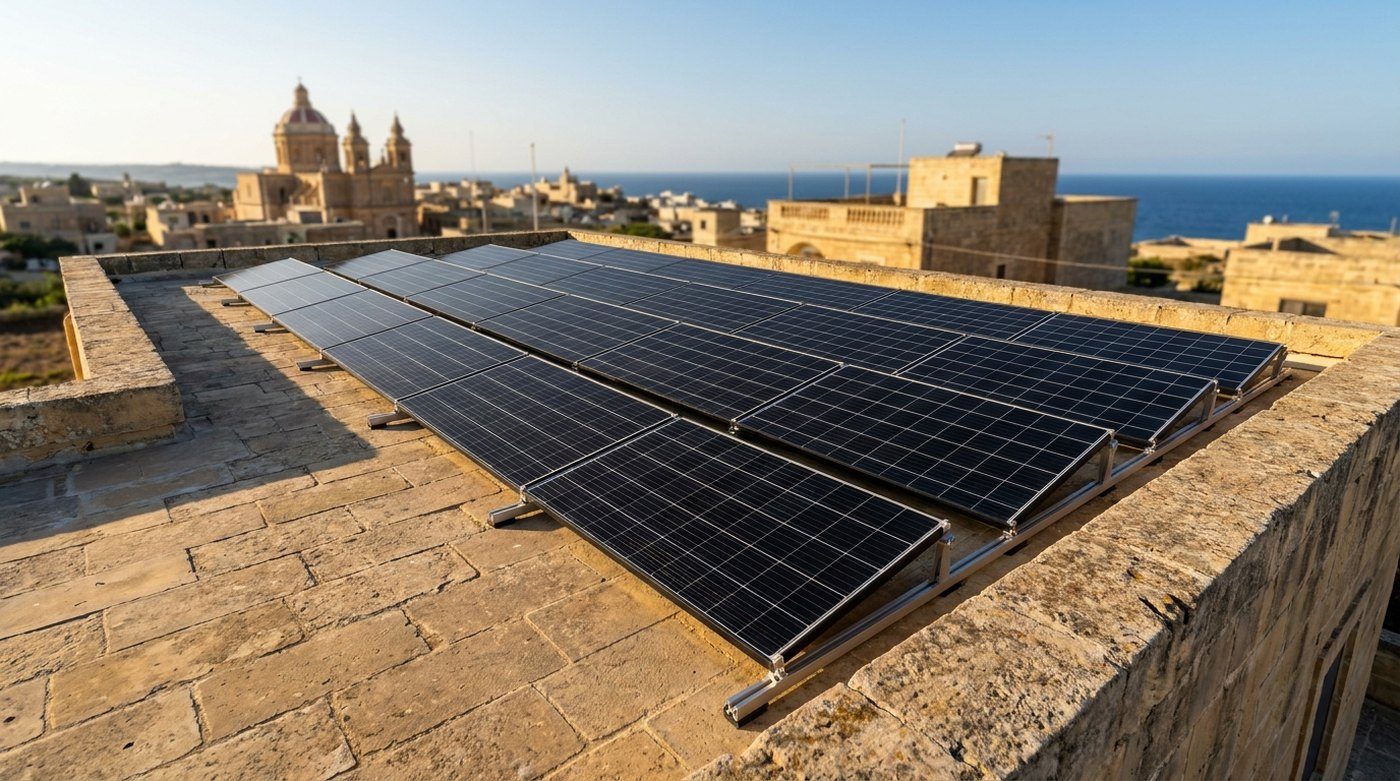
Most of what goes wrong with a solar installation in Malta goes wrong in the first week, not the last. The order matters — particularly the grant order, where applying in the wrong sequence disqualifies you outright. Here is the real sequence, with the parts nobody publishes flagged as such.
1. The roof survey
A survey is a physical inspection, not a satellite screenshot. On a Maltese roof the installer is looking at five things.
Orientation and tilt. This is the single biggest driver of output. PVGIS yields for Malta:
| Orientation | kWh per kWp per year |
|---|---|
| South, 32° tilt | 1,668 |
| Flat | 1,476 |
| East | 1,376 |
| West | 1,393 |
| Gozo (south) | 1,677 |
An east-facing array produces roughly 82% of what a south-facing one at 32° does. That is not a reason not to install — it is a reason to size differently and to be sceptical of any quote that quotes a single generic yield figure.
Shading. Neighbouring blocks, stairwell enclosures, lift overruns and the washing lines everyone forgets. Shade that lands for two hours in December is a different problem from shade that lands at noon in June.
The parapet. Maltese roofs have them, and they both shade low-mounted panels in winter and constrain how high you can build. They also matter legally on older buildings — see the planning section.
Water tanks and services. Roof-mounted tanks, solar water heaters, aircon condensers and satellite dishes all compete for the same clear area, and tanks cast long shadows.
That is building work, priced separately, and it should appear as its own line on the quote.
If you want a first pass before anyone visits, the roof planner at SpecYourSolar will get you to a plausible panel count and orientation.
2. Sizing against the Enemalta bill
Size the system against consumption, not against roof area. Enemalta's residential tariff is banded by annual consumption, and the bands escalate steeply — these rates include 5% VAT:
| Annual consumption | €/kWh |
|---|---|
| Up to 2,000 kWh | 0.1047 |
| 2,001–6,000 kWh | 0.1298 |
| 6,001–10,000 kWh | 0.1607 |
| 10,001–20,000 kWh | 0.3420 |
| Above 20,000 kWh | 0.6076 |
The jump from 0.1607 to 0.3420 is where the economics live. A household running air conditioning through a Maltese summer and sitting in the 10,000–20,000 kWh band is displacing electricity worth more than three times what the first 2,000 kWh costs. A frugal two-person flat at 3,000 kWh is displacing 0.1298. The same array has a completely different payback in those two homes, which is why a generic percentage bill saving is meaningless — ignore anyone who offers you one.
Bring twelve months of bills to the survey. The savings calculator on our homepage runs the same banded arithmetic if you want to sanity-check a quote.
3. The quote
Insist on an itemised quote: panel make, model and count; inverter make, model and whether it is hybrid; mounting and ballast; DC and AC cabling; any roof preparation; scaffolding or access; and the labour. One lump sum tells you nothing and cannot be compared.
Be honest with yourself about what you can verify on price. There is no neutral, dated, published installed price per kWp for Malta. The only figure in our sources is an installer's own guidance of €3,500–5,000 for a 3 kWp system before grant — undated, from a party with an interest, and low confidence. Treat it as a hint that prices are not absurd, not as a benchmark. The same is true of batteries: no published Malta price exists at all. Three itemised quotes are worth more than any number you read online, including that one. Installers listed in CheckYourSolar are CheckYourTraders-verified.
4. The planning check
Rooftop PV is permitted development under Class 1(iv) of the Development Notification Order (S.L. 552.08). Where the installation complies with DC15, no notification is required (guidance G26), and the array must not exceed the roof height limit.
Two categories are tighter. Scheduled buildings, and buildings more than 75 years old inside conservation areas, must have the installation kept within the building envelope and not above the parapet. In practice that constrains tilt and can push you towards a flatter, lower-yield layout — which is why the parapet measurement from step 1 is not a detail.
No separate environmental permit is involved in a standard domestic rooftop installation.
5. The grant sequence — and its current status
The 2026 RES scheme is closed to applications. It closed on 12 September 2026, and the battery options (B and C) closed at Part A on 13 July 2026. A further round has been announced, but no details have been published — not the rates, not the budget, not the opening date.
When a round is open, the sequence is rigid:
- Part A, before you purchase anything. Buying first disqualifies the application.
- Offer letter, valid for eight months. That is your installation window.
- Installation, using REWS-registered equipment, grid-connected, with a ten-year installer warranty.
- Part B, submitted with the fiscal receipt.
Eligibility under the 2026 guidelines: Malta resident aged 18 or over; owner, emphyteuta or long-lease holder; a residential-tariff bill in your name within the previous twelve months; not a landlord or business; no grant for a similar system since 2010; PV above 1 kW, battery above 2 kWh.
The 2026 rates, for reference if a further round resembles it: PV plus hybrid inverter at 65% of eligible cost, capped at €3,000 per system and €645/kWp; battery at 75%, capped at €6,000 and €600/kWh. Nothing guarantees the next round repeats these.
The five-year keep rule: you must keep the system in place for five years. Selling the property or stripping the panels inside that window puts the grant at risk.
Battery sizing, if a round opens with battery options, is covered in StoreYourSolar.
6. Installation and commissioning
Expect scaffolding or roof access arrangements, a day or two on the roof for a domestic array, DC work, inverter mounting, and the AC connection into your distribution board. In an apartment block, works to common parts are bound by condominium rules and need the agreement the deed requires — settle that before the offer letter clock starts, not after.
In Gozo, every delivery crosses on the ferry. That affects scheduling and the cost of a return visit if something arrives damaged. Ask how call-outs are handled before you sign.
The ten-year installer warranty is a grant condition, not a courtesy. Get it in writing, naming the installer.
7. Feed-in
Export is paid under one of two tariffs, and they are mutually exclusive with the grant:
- Grant-free: €0.15/kWh for 20 years, for systems under 40 kWp.
- Grant-assisted: €0.105/kWh for 20 years — that was the 2025 rate. The 2026 rate is not confirmed.
With the 2026 scheme closed, the grant-free route at €0.15/kWh is the one currently available to a household installing now. Whether waiting for the undetailed further round beats taking €0.15/kWh for twenty years is arithmetic that depends on rates nobody has published yet, and anyone telling you the answer with confidence is guessing.
Common questions
- Do I need a planning permit for rooftop PV in Malta?
- Rooftop PV is permitted development under Class 1(iv) of the Development Notification Order (S.L. 552.08), and no notification is needed where the installation complies with DC15 and does not exceed the roof height limit. Scheduled buildings, and buildings over 75 years old in conservation areas, must keep the array within the building envelope and not above the parapet.
- Can I buy the system first and apply for the grant afterwards?
- No. Under the 2026 RES scheme the sequence is Part A before purchase, then an offer letter valid eight months, then installation, then Part B with the fiscal receipt. Applying after you have bought the system breaks the sequence. The 2026 scheme closed to applications on 12 September 2026 (battery options B and C closed at Part A on 13 July 2026); a further round has been announced but not detailed.
- What will the system actually cost?
- Nobody publishes a neutral installed price for Malta. The only price figure in our sources is an installer's own undated guide of €3,500–5,000 for 3 kWp before grant, which is low-confidence and should not be treated as a market rate. Get itemised quotes from more than one installer.
- Can I take the grant and the €0.15/kWh feed-in tariff?
- No — the grant and the grant-free feed-in tariff are mutually exclusive. Grant-free export is €0.15/kWh for 20 years for systems under 40 kWp. The grant-assisted rate was €0.105/kWh for 20 years in 2025; the 2026 rate is not confirmed in our sources.
What we could not establish
- No neutral, dated 2026 installed price per kWp exists for Malta — the only figure in our sources is an undated installer guide.
- No published battery price for Malta, installed or per kWh.
- The grant-assisted feed-in tariff rate for 2026 is not confirmed; €0.105/kWh is the 2025 rate.
- The terms, budget, rates and opening date of the announced further grant round have not been published.
- REWS does not publish processing times for Part A or Part B, nor Enemalta's timeline for meter changeover and feed-in activation.
- Condominium consent requirements for apartment blocks are not addressed in any of the sources used here.
- No source quantifies any Gozo cost premium for delivery or labour.
Sources
- Guidelines for Applicants — 2026 RES scheme — REWS · read 2026-10-16
- Manual of Procedures, version 1 (24 November 2025) — REWS · read 2026-10-16
- 2026 Renewable Energy Sources Scheme — Regulator for Energy and Water Services (REWS) · read 2026-10-16
- Government incentives — PVMalta (installer) · read 2026-10-16
Drafted with Claude — claude-opus-5, then read, corrected and approved by Neil Bennett before publication. We do not publish anything a person has not read.
Want this costed properly?
The calculator gives you a figure in a minute. A site visit gives you a fixed price.
Book a free survey