
Do solar panels need planning permission in Malta?
In most cases no. Rooftop PV is permitted development under Class 1(iv) of the Development Notification Order (S.L. 552.08), and no notification is needed where the installation complies with DC15 guidance G26 and stays within the roof height limit. Scheduled buildings and buildings over 75 years old in conservation areas are the exception.
The short answer
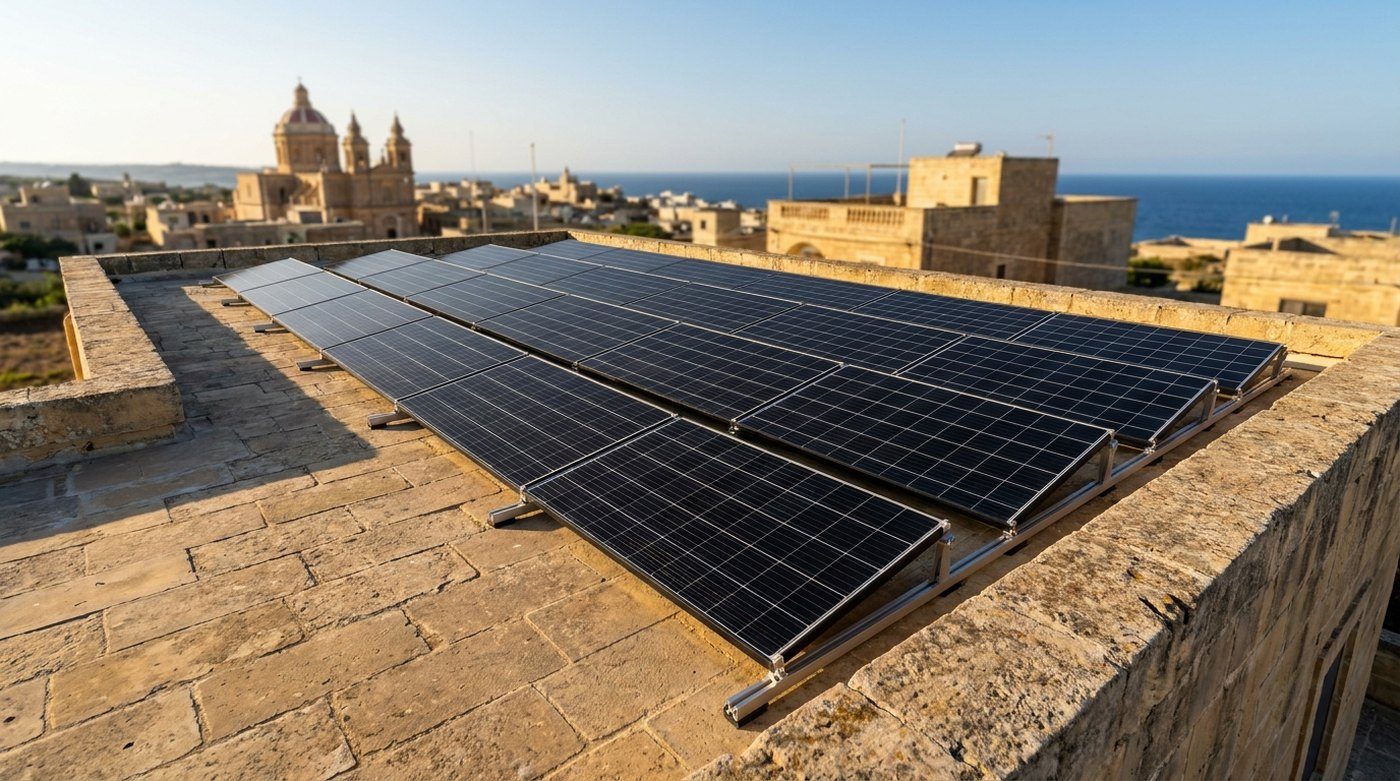
For a normal house roof in Malta or Gozo, no planning permission is needed to install solar panels, and in most cases no notification is needed either.
The REWS Manual of Procedures (version 1, 24 November 2025) states the position plainly: rooftop photovoltaic installations are permitted development under Class 1(iv) of the Development Notification Order, S.L. 552.08. Permitted development means the law has already granted consent for that category of work, so there is no application to submit and no decision to wait for.
The Manual attaches two conditions to the no-notification route:
- the installation complies with DC15, specifically guidance G26; and
- the installation does not go above the roof height limit.
Meet both and the work proceeds without notifying the planning authority. Fail either and you are outside the simple route, and the question of what consent is required becomes a live one.
What "permitted development" actually means
British arrivals will recognise the term, and it works the same way here in principle: a class of development is deemed acceptable in advance, so individual scrutiny is skipped. The Maltese instrument is the Development Notification Order, S.L. 552.08, and rooftop PV sits in Class 1(iv).
Two things follow from that, and both matter.
First, you are not being granted a discretionary favour. If your installation fits the class and meets the conditions, the permission already exists; nobody has to agree with your aesthetics.
Second, the conditions are not optional decoration. Permitted development is conditional development. An array that breaches the roof height limit is not covered by the class, whatever the installer told you on the phone.
The two conditions, read carefully
DC15 compliance, guidance G26. The Manual of Procedures names DC15 and guidance G26 as the compliance test for rooftop PV. It does not reproduce the text of G26, so this article cannot set out the detailed design criteria without inventing them. What we can say is that compliance with G26 is the stated precondition for proceeding without notification, which makes it a question to put to your installer before the panels are ordered, not after. Ask directly: is this layout DC15-compliant under G26? An installer who cannot answer that question has told you something useful about themselves. The verified installer directory exists partly for this reason.
The roof height limit. The Manual states that the installation must not be above the roof height limit. It does not give a figure, and we are not going to supply one from memory. The practical consequence is about mounting geometry: the taller the frame, the steeper the tilt, the higher the back edge of each row sits above the roof. On a flat Maltese roof this is a real design constraint rather than a theoretical one, and it interacts with the usual trade-off between tilt and yield. Our free roof planner deals with the layout side of that; the height compliance question belongs with whoever signs off the design.
The exceptions: scheduled buildings and old buildings in conservation areas
Two categories are singled out in the Manual.
- Scheduled buildings.
- Buildings over 75 years old that are located within conservation areas.
For both, the panels must be kept within the building envelope and must not rise above the parapet.
This is a design constraint with teeth. A great many older Maltese and Gozitan townhouses have a parapet wall around a flat roof, and the whole point of a tilted frame is to lift the back of the panel. Staying below the parapet line can mean a shallower tilt, fewer rows, a smaller array, or in some cases a roof that will not take a sensible system at all. "Within the envelope" likewise rules out oversailing the roof edge to win a few more modules.
If you are buying a property in Valletta, the Three Cities, Mdina, Victoria or any of the older cores, treat this as a pre-purchase question rather than a post-purchase discovery. Age plus conservation-area location is the trigger; either alone is not what the Manual describes.
The ERA permit myth
A persistent claim circulating about Maltese solar is that an Environment and Resources Authority permit is required before panels can go on a roof. The Manual of Procedures does not describe any such route for rooftop PV. It describes one route: permitted development under DNO Class 1(iv), with no notification where DC15 guidance G26 is met and the roof height limit is respected. Nothing in the source introduces an ERA permit into that chain for a domestic rooftop array.
If someone quotes you for "ERA permit handling" on a standard house roof, ask them which instrument requires it. The burden of proof is theirs.
What permitted development does not cover
Planning status is one layer. It is not the whole stack, and conflating the two is how people end up surprised.
- Electrical and grid matters. Connection to the distribution network, metering and the technical standards for the installation are separate processes with their own requirements. Permitted development says nothing about them.
- Ownership and condominium rules. In an apartment block the roof is frequently common property. Whether you may install on it, and on what terms, is settled by the deed and the condominium rules, not by S.L. 552.08. The Manual does not address this at all.
- Non-rooftop installations. The class cited is for rooftop PV. Ground-mounted arrays, façade panels and canopies are not addressed in the source, so do not assume the same answer applies.
- Batteries. The Manual's planning statement is about rooftop PV. Storage siting raises its own questions; our battery guide covers what is and is not established.
Grants and planning are separate questions
For completeness, because readers invariably ask: the 2026 REWS RES grant closed to applications on 12 September 2026, with the battery options closing on 13 July 2026. A further round has been announced but not detailed — no rates, no conditions, no opening date are available. Planning status is not a grant condition in anything the source establishes, and nothing here should be read as a prediction about a scheme whose terms do not yet exist.
The grant-free feed-in tariff for systems under 40 kWp is €0.15/kWh for 20 years. The grant-assisted rate was €0.105/kWh in 2025; the 2026 rate is unconfirmed. Those figures sit alongside the planning position rather than depending on it.
What to do with this
- Establish whether the building is scheduled, and whether it is over 75 years old and in a conservation area. If either applies, the envelope and parapet limits govern the design from the outset.
- For everything else, confirm with your installer that the proposed layout is DC15-compliant under guidance G26 and does not exceed the roof height limit.
- If both are confirmed, no notification is required and there is no planning queue to join.
- Settle ownership and condominium consent separately, in writing, before any delivery is booked — and for Gozo, before a ferry slot is booked with it.
Common questions
- Do I need a planning permit to put solar panels on my roof in Malta?
- Usually not. Rooftop photovoltaics are permitted development under Class 1(iv) of the Development Notification Order (S.L. 552.08). Where the installation complies with DC15 guidance G26 and does not go above the roof height limit, no notification is required either.
- Do I need an ERA permit for solar panels?
- The REWS Manual of Procedures sets out the planning route for rooftop PV as permitted development under the DNO. It does not route domestic rooftop PV through an Environment and Resources Authority permit. The claim that an ERA permit is required for a normal house roof array is not supported by the Manual.
- What if my house is in a conservation area or is a scheduled building?
- Scheduled buildings, and buildings over 75 years old that sit within conservation areas, are treated differently: the panels must stay within the building envelope and must not rise above the parapet. That constrains both the layout and, in practice, the number of panels you can fit.
- Does permitted development mean I can skip the installer paperwork too?
- No. Permitted development is a planning status only. It says nothing about electrical compliance, grid connection with the distribution network operator, or the conditions attached to any support scheme. Those are separate processes with their own requirements.
- My flat's roof is shared. Does planning law settle who may use it?
- No. Planning status and ownership are different questions. Whether you may use a common roof is governed by the deed and the condominium rules, not by the Development Notification Order, and the Manual of Procedures does not address it.
What we could not establish
- The Manual of Procedures cites DC15 guidance G26 as the compliance test but does not reproduce its text, so the detailed design criteria a compliant array must meet are not established here.
- The numeric roof height limit is not stated in the source — only that the installation must not exceed it.
- The source does not address ground-mounted arrays, façade-mounted panels, canopies or carports; the permitted development class cited is for rooftop installations.
- Nothing in the source covers condominium consent, shared roof ownership or airspace rights in blocks of flats, which is a civil-law matter rather than a planning one.
- The source does not say who certifies DC15 compliance, or whether any record of that assessment has to be kept or produced later.
- Whether planning status interacts with eligibility for any future grant round is not established, because the further round announced after the 2026 scheme closed has not been detailed.
Sources
- Manual of Procedures, version 1 (24 November 2025) — REWS · read 2026-10-16
Drafted with Claude — claude-opus-5, then read, corrected and approved by Neil Bennett before publication. We do not publish anything a person has not read.
Want this costed properly?
The calculator gives you a figure in a minute. A site visit gives you a fixed price.
Book a free survey