
Solar panels on apartments and shared roofs in Malta
Rooftop PV is permitted development under DNO Class 1(iv), and the 2026 REWS grant set out exactly who could apply. Neither source says who owns the roof of a block of flats — that question belongs to your deed and your condominium rules.
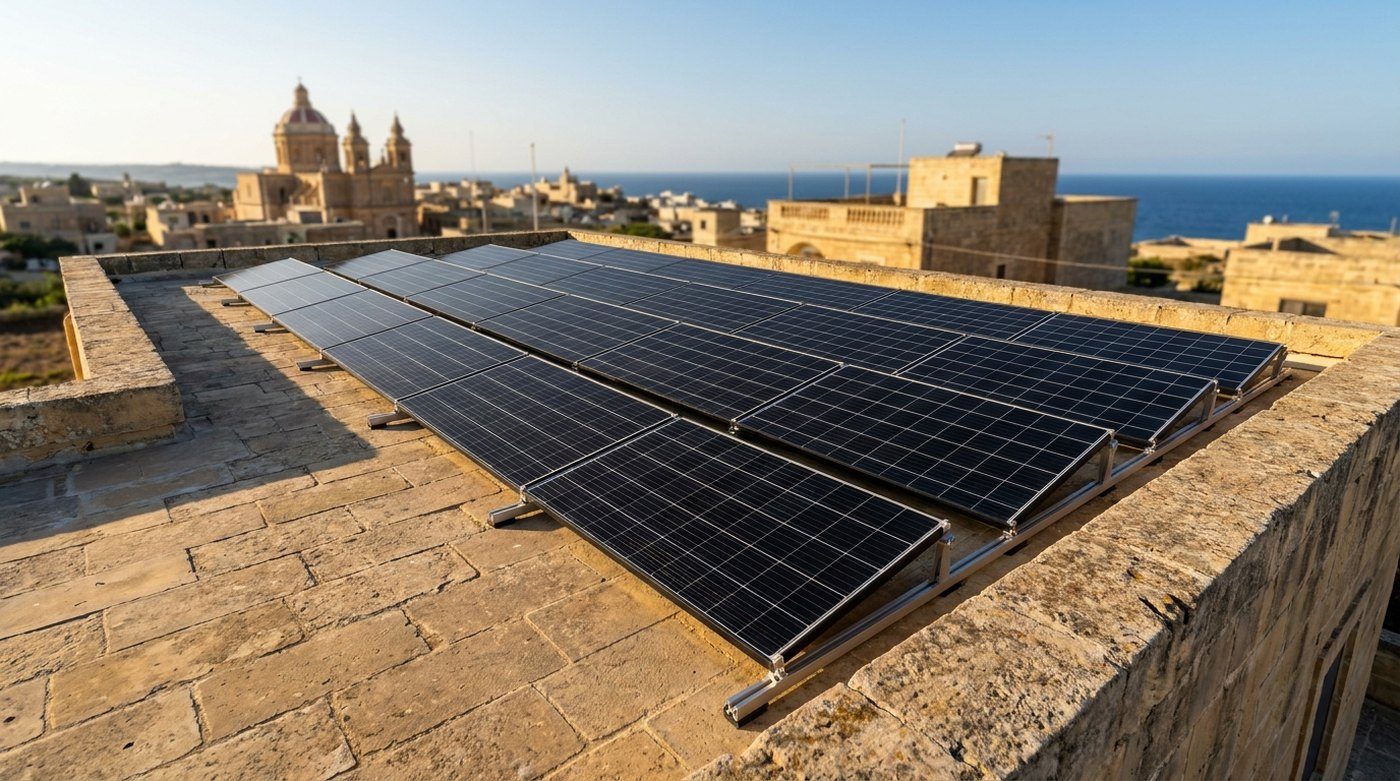
Most homes in Malta are not detached houses with a roof that unambiguously belongs to them. If you are weighing up solar in a flat, you are really facing two separate questions. One of them has a published answer. The other does not, and this article is explicit about which is which.
Planning is usually the easy part
The REWS Manual of Procedures (version 1, 24 November 2025) states that rooftop photovoltaic installations are permitted development under DNO Class 1(iv) of S.L. 552.08. Where the installation complies with DC15, no notification is required — this follows guidance G26. The panels must not exceed the roof height limit.
The Manual does not draw a distinction between the roof of a villa and the roof of an apartment block. The class is about rooftop PV. So the planning route for a block of flats in Sliema is, on the face of it, the same as for a terraced house in Żejtun: if the installation is DC15-compliant and stays within the height limit, it is permitted development.
Scheduled buildings and older conservation-area properties
There is a tighter rule for two categories: scheduled buildings, and buildings more than 75 years old within conservation areas. For these, the installation must sit within the building envelope and must not rise above the parapet. That catches a great many older apartment conversions in Valletta, the Three Cities, Mdina, the Rabat and Birkirkara cores, and Victoria in Gozo.
The practical consequence is a yield one. Tilt frames that lift panels clear of a low parapet are off the table, so arrays end up laid closer to flat. On PVGIS figures for Malta, a south-facing array at 32 degrees returns 1,668 kWh/kWp while a flat array returns 1,476 kWh/kWp — about 11% less per kWp installed. East-facing gives 1,376 and west-facing 1,393. Gozo south-facing gives 1,677. On a small roof shared with water tanks, washing lines and a stairwell head, that difference decides whether a system is worth building at all. Our free roof planner is built around measuring the usable area before anyone quotes.
Who the 2026 grant let apply
The Guidelines for Applicants for the 2026 RES scheme set eligibility that matters a great deal to anyone in a flat:
- Malta resident, aged 18 or over
- Owner, emphyteuta or long lessee of the property
- A residential-tariff bill issued within the previous 12 months
- No landlords and no businesses
- No grant received for a similar system since 2010
- PV larger than 1 kW; battery larger than 2 kWh
- REWS-registered equipment, grid-connected
- System kept five years; ten-year installer warranty
- Part A submitted before purchase, offer letter valid eight months, then installation, then Part B with the fiscal receipt
So a tenant could not apply, and neither could a landlord wanting to fit panels on a rented flat. An emphyteuta or a long lessee could. The grant and the grant-free feed-in tariff were mutually exclusive — you chose one route.
The published rates were 65% of eligible cost for PV plus a hybrid inverter, capped at €3,000 per system and €645/kWp; and 75% for batteries, capped at €6,000 and €600/kWh.
The scheme is closed. Applications closed on 12 September 2026, and battery options B and C closed at Part A stage on 13 July 2026. A further round has been announced, but it has not been detailed — no opening date, no rates, no eligibility criteria have been published. Treat every grant figure above as a record of what the 2026 round paid, not a prediction of what a future round will pay.
The route that does not need a grant
For systems under 40 kWp, the grant-free feed-in tariff is €0.15/kWh for 20 years. The grant-assisted tariff was €0.105/kWh in 2025 and the 2026 rate is unconfirmed.
This matters more in a flat than in a house. Flats are often small, often empty during the working day, and often have less roof than they have demand. A high proportion of generation is exported rather than self-consumed, which makes the export rate the dominant number in the arithmetic.
Set it against Enemalta's residential bands, which include 5% VAT and step up with cumulative annual consumption:
| Annual consumption | Rate (€/kWh) |
|---|---|
| up to 2,000 kWh | 0.1047 |
| up to 6,000 kWh | 0.1298 |
| up to 10,000 kWh | 0.1607 |
| up to 20,000 kWh | 0.3420 |
| above 20,000 kWh | 0.6076 |
A low-consumption flat sitting in the 0.1047 band earns more by exporting at €0.15 than it saves by self-consuming. A household running air conditioning hard enough to reach 0.3420 or 0.6076 gains far more from using its own generation on site — which is the case where a battery changes the answer, and where our battery guide is the place to start. You can run your own consumption through the savings calculator.
What the sources do not settle: who owns the roof
Nothing in the Manual of Procedures or the REWS scheme documents tells you whether you are entitled to put anything on the roof of your block. Specifically, our sources do not cover:
- whether the roof or the airspace above it was conveyed with your flat, retained by the developer, or left in common ownership
- what consent, if any, the other owners or the condominium administrator must give
- how a shared roof is divided between several units, and whether each unit can hold a separate connection and its own feed-in agreement
- what happens to the installation, and to a 20-year feed-in contract, when a flat is sold
The Condominium Act (Cap. 398) is the obvious place these answers live, and it is not yet in our sources, so we are not going to summarise it from memory. A planning class that says "permitted development" is not permission from your neighbours.
A sensible order of operations
- Pull the deed. Establish who owns the roof and the airspace, with a notary if the wording is not obvious.
- Check the condominium rules for works on common parts, and get whatever consent they require in writing.
- Confirm whether the building is scheduled or over 75 years old in a conservation area — that sets the parapet constraint.
- Measure the usable roof area, after tanks, access and shading, with our roof planner.
- Model the economics on your own bill, then decide between the grant-free feed-in tariff and waiting for a further grant round that has not been detailed.
For Gozo, add delivery to the sequence: every panel, inverter and battery crosses on the ferry, and that shows up in lead times rather than in yield — the Gozo PVGIS figure of 1,677 kWh/kWp is marginally better than Malta's 1,668.
How our installers are checked is set out at CheckYourSolar, and a free roof survey will tell you what will physically fit. Neither of those resolves the ownership question. Only your deed does.
Common questions
- Do I need planning permission to put panels on the roof of my block of flats?
- Rooftop PV is permitted development under DNO Class 1(iv) of S.L. 552.08, and the REWS Manual of Procedures states that no notification is needed where the installation complies with DC15 (guidance G26). The panels must not go above the roof height limit. On scheduled buildings, and on buildings more than 75 years old within conservation areas, the installation must stay within the building envelope and not rise above the parapet. Planning status is separate from the question of whether you are entitled to use the roof at all.
- Could a tenant apply for the 2026 solar grant?
- No. The Guidelines for Applicants required the applicant to be the owner, emphyteuta or long lessee of the property, to be a Malta resident aged 18 or over, and to hold a residential-tariff bill issued within the previous 12 months. Landlords and businesses were excluded. The scheme closed to applications on 12 September 2026 — battery options B and C closed at Part A stage on 13 July 2026 — and although a further round has been announced, no details have been published.
- Can two flats in the same block each have their own system on one roof?
- The sources do not say. REWS sets eligibility per applicant and the planning class covers rooftop PV generally, but nothing in the Manual of Procedures or the scheme guidelines addresses how a single roof is divided between separate dwellings, how many connections a roof may carry, or who consents to the division. That is a matter for your deed and your condominium rules, and it needs a notary or lawyer.
- If my panels are forced flat behind a parapet, how much do I lose?
- PVGIS yields for Malta are 1,668 kWh/kWp for a south-facing array at 32 degrees and 1,476 kWh/kWp flat, so a flat-mounted array produces roughly 11% less per kWp than an optimally tilted one. East-facing gives 1,376 and west-facing 1,393. In Gozo the south-facing figure is 1,677 kWh/kWp.
What we could not establish
- Roof and airspace ownership in Maltese flats — whether the roof was conveyed with the top-floor unit, retained by the developer, or held in common — is not addressed by any of our sources. The Condominium Act (Cap. 398) is not yet in SOURCES.md.
- Condominium consent: what majority, if any, is needed to install PV on a common roof, and whether an administrator can refuse, is not established here.
- How a shared roof may be divided between several flats, and whether each unit can hold a separate grid connection and feed-in agreement from the same roof, is not covered.
- Whether the 2026 rule excluding anyone who received a grant for a similar system since 2010 attaches to the applicant or to the dwelling — which matters where a block changes hands or where several flats apply.
- Details of the further grant round: no opening date, rates, caps or eligibility criteria have been published.
- The 2026 grant-assisted feed-in tariff rate is unconfirmed. The 2025 rate was €0.105/kWh.
- There is no neutral published installed price per kWp for PV in Malta in 2026, and no published Malta battery price. Any figure you are quoted is a supplier's figure, not a market rate.
- Nothing in the sources covers offsetting the electricity used by common parts — lifts, stairwell lighting, pumps — from a communal array.
Sources
- Manual of Procedures, version 1 (24 November 2025) — REWS · read 2026-10-16
- Guidelines for Applicants — 2026 RES scheme — REWS · read 2026-10-16
- 2026 Renewable Energy Sources Scheme — Regulator for Energy and Water Services (REWS) · read 2026-10-16
Drafted with Claude — claude-opus-5, then read, corrected and approved by Neil Bennett before publication. We do not publish anything a person has not read.
Want this costed properly?
The calculator gives you a figure in a minute. A site visit gives you a fixed price.
Book a free survey